Get Full Government Meeting Transcripts, Videos, & Alerts Forever!
Get email alerts on the Transfer Tax Free City College topic
No spam. Unsubscribe anytime.
Committee approves transfer‑tax measure and resolution of intent to fund Free City College, amid debate over revenue sources and program guarantees
Summary
The Budget & Finance Committee approved a measure to raise the real property transfer tax on sales of $5M+ (creating a top rate of 3% on sales over $25M) and a companion resolution expressing intent to use new revenue to make City College free for eligible San Franciscans; supervisors and analysts debated whether most revenue would come from commercial sales and emphasized the need for reserve and eligibility rules.
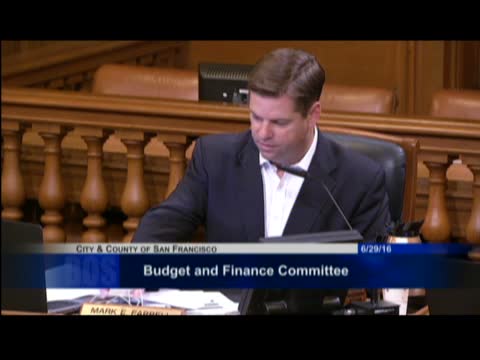
The San Francisco Budget & Finance Committee on June 29 voted 4–1 to move forward a proposed increase in the real property transfer tax for properties selling for $5,000,000 or more and to approve a companion resolution of intent to prioritize new revenue for making City College tuition‑free for eligible San Franciscans.
Supervisor Jane Kim described the proposal as a modest set of rate increases that would create a new top bracket of 3% for sales above $25,000,000 and said the city economist estimated the measure would generate about $44 million a year on average. Kim framed the measure as a way to fund Free City College and other city needs such as housing, transit and libraries while creating an accountability vehicle (the Free City College Fund) for new revenue.
Ted Egan of the Comptroller’s Office presented an economic impact report, emphasizing the transfer tax is applied to sales above $5,000,000 and that revenue estimates are volatile. Egan’s office ran multiple scenarios and estimated long‑run average revenue at about $44,000,000 per year, with a historical range from as little as roughly $5–10 million in low years to $70–90 million in high years. The analysis focused on commercial property effects and projected a small net GDP impact and a potential loss of 20–70 private‑sector jobs over 20 years, partially offset by increased public investment. Egan also said the bulk of economic impact would likely occur through commercial property sales.
Several supervisors and members of the public noted that while the campaign uses the term “mansion tax,” controller and realtor data suggest most revenue would come from commercial and multifamily transactions rather than single‑family luxury home sales. Jay Chang of the San Francisco Association of Realtors said residential sales would have contributed only about $1.2 million of the projected $44 million in 2015, or roughly 2.7% of the total, and argued the measure functions largely as a commercial transfer tax. Controller staff offered to provide a more precise breakdown.
City College representatives and unions strongly supported the Free City College component. Ron Gerhard (vice chancellor for finance and administration, City College of San Francisco) said the program’s cost depends on participation rules: City College currently collects about $12.9 million in student enrollment fees; using controller scenarios, a full fee buyout in today’s enrollment could cost in that range (roughly $13M), with higher costs if enrollment rises. Speakers from AFT 2121, the San Francisco Labor Council and many students and community advocates urged the board to adopt the resolution and to pursue the revenue measure.
Supervisors raised implementation questions: how to define eligible students (residents and those working half‑time in San Francisco), how to verify work eligibility, what reserve policy would protect City College in down markets given transfer tax volatility, and how to ensure annual appropriations reflect the board’s intent. Supervisor Scott Wiener and others emphasized the transfer tax proceeds are general fund revenue under state law and that funding City College would be an annual appropriation, subject to budgetary decisions in future years.
The committee approved the transfer‑tax ordinance motion (item 3) on roll call (Tang, Yi, Kim, Wiener — Aye; Farrell — No) and also voted to approve the Free City College intent resolution (item 4) by the same 4–1 tally. The committee duplicated item 4 as a separate file to allow Supervisor Yi to pursue amendments addressing childcare and broader student support; the duplicated file will be continued to the call of the chair for additional committee consideration.
Next steps: the transfer‑tax ordinance will be placed on the November ballot if the sponsor proceeds; City College and staff will work on eligibility rules, fund language and a reserve policy to manage revenue volatility before the measure reaches the full Board.