Get Full Government Meeting Transcripts, Videos, & Alerts Forever!
Get email alerts on the Departmental Budgets topic
No spam. Unsubscribe anytime.
Budget hearings: Port seawall planning, library hours expansion, PUC drought impacts and MTA fare changes among highlights
Summary
At Wednesday’s Budget & Finance Committee, department heads presented two‑year budgets: Port staff got an $8 million seawall resiliency planning allocation; the Public Library proposed expanded hours and capital scoping; PUC flagged drought-related revenue pressure and CleanPowerSF costs; and the MTA approved fare changes including a 25¢ cash fare differential and youth definition extension to age 18.
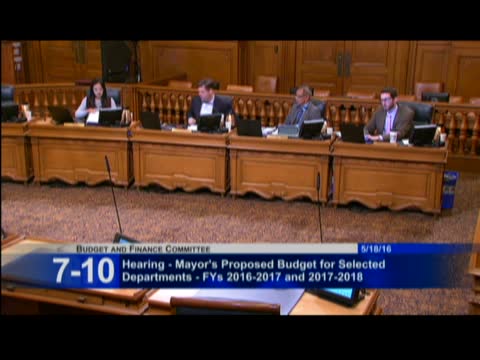
Multiple city departments and enterprises presented their two‑year budget priorities to the Board’s Budget & Finance Committee on Wednesday.
Port and seawall: Elaine Forbes, interim Port director, said the port proposed $61.2 million in capital investments over two years and that the mayor’s office supports an $8,000,000 allocation to begin a two‑year seawall resiliency planning project. Forbes said the funds will support outreach, engineering analysis and environmental review for the three‑mile seawall from Fisherman’s Wharf to Mission Creek.
Library and digital services: City Librarian Luis Herrera proposed expanding baseline branch hours to a minimum of 50 per week at 14 neighborhood branches, added staffing (21 FTEs in FY17, 13 in FY18), and capital scoping funds ($900,000 in FY17 and $5,000,000 in FY18) for renovations at Chinatown, Mission and Ocean View branches. Herrera emphasized digital inclusion measures, mobile MiFi lending and expanded youth services at the Mix.
PUC and CleanPowerSF: Harlan Kelly, general manager of the Public Utilities Commission, said CleanPowerSF rollout has had a low opt‑out rate under 1% and that drought‑driven declines in retail water sales require rebalancing revenue assumptions; PUC plans targeted staff for CleanPowerSF phases and to accelerate capital replacement programs such as Calaveras Dam and recycled water projects.
MTA fare policy and use of fund balance: MTA Director Ed Riskin summarized board‑adopted fare proposals that would harmonize the youth definition to ages 5–18, reduce some discounts for higher‑income seniors/disabled riders, and establish a 25¢ differential for cash or limited‑use tickets versus Clipper or Muni Mobile payments. Riskin said the agency will use portions of an elevated fund balance for one‑time safety and reliability investments and noted federal safety management requirements that will require more resources.
Board of Appeals and law library: Cynthia Goldstein reported a 29% year‑to‑date increase in appeals due to clustered filings and said surcharge revenue and a reserve should cover modest planned expenditure increases. Stella of the law library reported stable operations, high satisfaction and increased electronic reference work following a recent relocation.
Public comment: A neighborhood coalition asked supervisors to place $25,000,000 of general fund monies allocated to the MTA on reserve until community impacts of Muni Forward projects are resolved; another speaker, Gilbert Criswell, supported the 25¢ cash fare differential and urged more outreach on Central Subway planning.
Why it matters: These departmental presentations set priorities and resource requests that the Board and budget analysts must reconcile in the final budget. The Port seawall planning funds, library capital scoping, CleanPowerSF implementation staffing, and MTA fare policy changes each carry operational and equity consequences that will recur in budget deliberations.