Get Full Government Meeting Transcripts, Videos, & Alerts Forever!
Get email alerts on the Homeless Services Reorg topic
No spam. Unsubscribe anytime.
City plan to stand up Department of Homeless Services aims to house 8,000 over four years
Summary
Sam Dodge presented plans for a Department of Homeless Services to centralize homelessness efforts, citing goals to end homelessness for 8,000 people in four years, a recent nearly $31 million HUD award, a $241 million homelessness spending distribution, and system improvements including coordinated entry, a client database and weekly dashboards to track point‑in‑time counts.
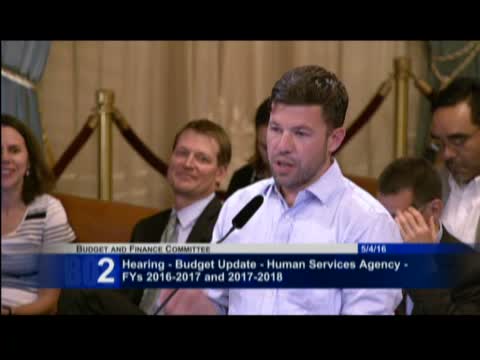
Sam Dodge told the Budget and Finance Committee that the mayor and Human Services Agency are advancing a proposal to create a separate Department of Homeless Services to centralize programs now spread across city agencies. Dodge said the new department would coordinate prevention, street outreach, navigation centers, transitional housing, rapid rehousing and permanent supportive housing.
"The basic idea is to end the homelessness for 8,000 people over the next 4 years," Dodge said, and added that the plan emphasizes housing‑first, trauma‑informed customer service and transparent placement decision‑making. He said the city won an almost $31,000,000 HUD award this year and that the broader homelessness spending package he referenced totals about $241,000,000, with the lion’s share invested in supportive housing for formerly homeless medically frail residents.
Dodge acknowledged tradeoffs: a record HUD award coincided with some cuts to job programs funded through federal processes. He said the new department would pull rapid‑rehousing, prevention, street outreach and other programs together so clients see a single spectrum of services rather than siloed programs across providers and departments.
On performance measures, Dodge described plans for a weekly dashboard, point‑in‑time counts and macro indicators such as how many people have been housed and timelines for rehousing. He told supervisors that supportive housing and rapid rehousing programs have shown very high success rates in local tracking: "well over 90 or 95 percent" of participants remain stably housed in the programs he described.
Dodge and supervisors also compared San Francisco’s system to New York City’s, noting scale differences and legal contexts. He said San Francisco’s nightly shelter capacity is roughly 1,300–1,600 beds and cited a city point‑in‑time count of about 6,700 people, with roughly 3,500 described as living on the street under the city's counting methodology.
Next steps: Dodge said the administration is in a director search for the new department and plans a transfer of functions through the budget process. The committee took no final vote on standing up the department and continued the HSA matter for future action.