Get Full Government Meeting Transcripts, Videos, & Alerts Forever!
Get email alerts on the Human Services Budget topic
No spam. Unsubscribe anytime.
Human Services Agency outlines reforms to speed benefits, reduce foster‑care stays
Summary
HSA Director Trent Ruhr told the Board of Supervisors’ budget committee that Medi‑Cal enrollments have surged while eligibility staffing lags, CalFresh penetration remains under half of eligible households, and a new Project 500 will target 500 of the city’s lowest‑income families with cross‑agency services. Ordinance changes and an evaluator RFP are planned.
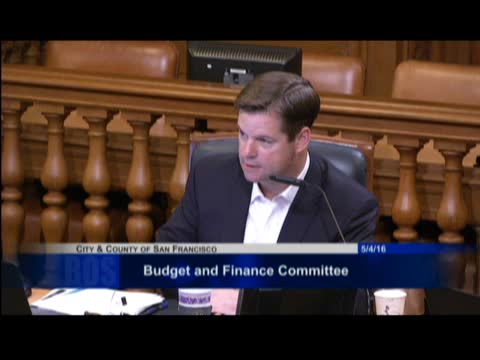
Trent Ruhr, director of the Human Services Agency, told the Budget and Finance Committee on May 4 that San Francisco’s recent growth in Medi‑Cal enrollments and other safety‑net programs is putting strain on local eligibility and service systems. "Since we began implementation in January of '14, we've now reached more than a 120,000 cases," Ruhr said, and he warned the Medi‑Cal case load has grown far faster than staff capacity.
Ruhr said the Medi‑Cal case load rose roughly 174% while eligibility worker staffing increased about 28 percent, creating long phone wait times and high abandoned‑call rates. He said the agency will propose in June a budget to add eligibility staff for Medi‑Cal and CalFresh and to accelerate business‑process changes that allow a single worker to determine eligibility for multiple programs. "Our goal is to have wait times of less than 30 seconds," he said.
On food benefits, Ruhr said CalFresh penetration is ‘‘only 50 to 55%’’ of those who are eligible and described an outreach strategy to enroll people who newly enroll in Medi‑Cal into CalFresh as well. He said the agency is pursuing integrated eligibility work so households can be screened for multiple benefits by one caseworker.
Ruhr reviewed safety‑net cash assistance and workforce efforts for single adults, and said the county will propose amendments to the County Adult Assistance Program ordinance to simplify application and ongoing eligibility rules so able recipients can move more quickly into subsidized and unsubsidized employment.
The director outlined Project 500, a cross‑agency initiative to target roughly 500 of the city’s lowest‑income families with intensive, two‑generation services — housing supports, job training, behavioral‑health treatment and home visiting for parents with newborns. "We just launched Project 500. We haven't even enrolled the first family yet," Ruhr said, and he told supervisors the city has issued an RFP for an independent third‑party evaluator to define family‑level and program benchmarks.
On child welfare, Ruhr highlighted reforms aimed at keeping families intact when possible, shortening foster‑care stays and improving reunification and adoption outcomes. He described the state’s Title IV‑E waiver as a key tool that allows federal funds to be used for preventive, in‑home services rather than only after removal from the home. "With the 40 waiver, it's basically essentially a block grant of federal money and we can do with it whatever we think is in the best interest of families in San Francisco," he told the committee.
Supervisors pressed for metrics and timing. Supervisor Kim asked about average lengths of stay in foster care and historical caseloads; Ruhr said San Francisco’s foster population had fallen from a high of about 2,800 roughly a decade earlier to below 700, and that about 250 additional youth remain in care as non‑minor dependents under AB 12 (ages 18–22). Ruhr said long‑term benchmarks and performance measures will be included in the fuller June presentation.
Next steps: HSA will return in June with more detailed ordinance language and budget proposals, plus the evaluator's scope for Project 500. The committee continued the item to the call of the chair.