Get Full Government Meeting Transcripts, Videos, & Alerts Forever!
Get email alerts on the Homeless Services topic
No spam. Unsubscribe anytime.
Supervisor Matt Haney and colleagues advance ordinance to require navigation centers or alternatives across San Francisco
Summary
The Government Audit and Oversight Committee advanced amendments to an ordinance directing HSH to open navigation centers or equivalent temporary shelters in districts without them, added flexibility for alternative facilities, and continued the measure for further work and finalization.
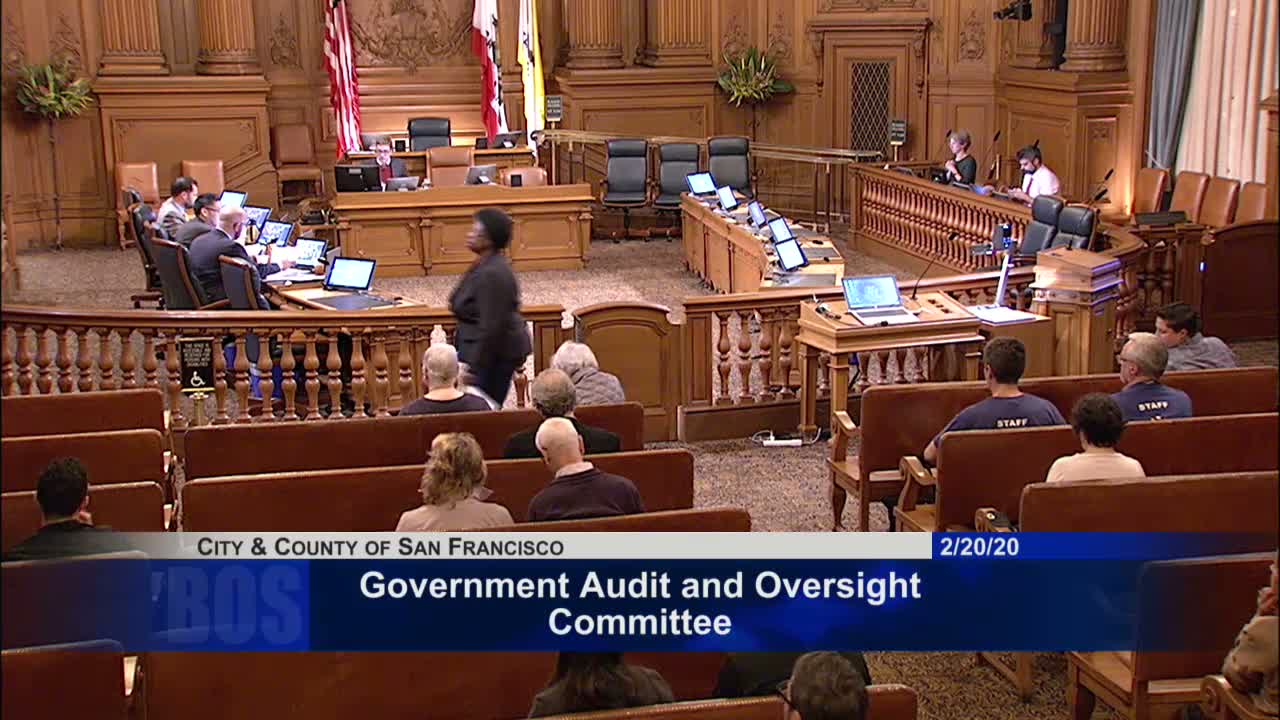
San Francisco — The Board of Supervisors’ Government Audit and Oversight Committee on Feb. 20 advanced amendments to an ordinance that would require the Department of Homelessness and Supportive Housing (HSH) to open navigation centers or approved temporary shelter alternatives in supervisorial districts that lack them.
Supervisor Matt Haney, sponsor of the ordinance, told the committee the navigation‑center model is a “high‑service, low‑barrier” approach that offers 24/7 access, on‑site case management and services, and accommodations for pets, partners and possessions. Haney cited program results from the city’s pilots and early rollouts, saying 52% of clients who exited navigation centers between 2016 and October 2019 left to permanent housing, temporary housing or reunification, and that more than 5,000 clients had been served through November 2019.
The amendments approved in committee added flexibility for districts where a navigation center might not be feasible. That flexibility allows other temporary shelters — including traditional shelters, transitional housing or stabilization beds that serve at least 30 people — to count toward the ordinance’s district‑level commitments, subject to feasibility determinations by HSH and the district supervisor. The committee also accepted changes that revise operational standards (including clarifications about assessments, storage for residents, on‑site services and bed‑holding rules), require development of fair‑share siting criteria and good‑neighbor outreach plans, and set department deliverables and timelines for site lists and an implementation‑funding plan.
Supervisor Rafael Mandelmann, participating as a substitute member, warned that strict specifications for what constitutes a navigation center could slow projects and that some districts lack parcels or buildings that meet the code’s size and safety requirements. Mandelmann and others pressed for realistic timeframes; the discussion included a staff comment from the Budget and Legislative Analyst that three leases were pending — two scheduled to open in the fall — such that an initial six‑month opening timetable for two centers could be met if schedules held.
Public testimony included dozens of speakers. Advocates, providers and residents urged expansion of navigation centers citywide while emphasizing that they are not substitutes for permanent supportive housing. Several speakers warned against using nav centers as rationale for enforcement actions or as a way to avoid providing housing exits.
Committee action and next steps
The committee approved textual changes to section 106.3.1 and an additional finding that acknowledged some districts may be more suited to permanent supportive housing or transitional facilities if parcels for nav centers are not available. Votes on specific motions were recorded by roll call; Supervisor Matt Haney voted "no" on at least two recorded roll‑call questions, while Supervisors Mandelmann and Marr voted "aye." Given the substantive nature of amendments, Chair Marr moved — and the committee accepted — continuing the ordinance to the call of the chair so staff and departments can finalize language and implementable timelines.
What happens next
The ordinance will return to the Government Audit and Oversight Committee for further consideration and then, if advanced, to the full Board of Supervisors. The ordinance as amended requires HSH and city departments with site control to produce lists of candidate sites and an HSH funding and implementation plan within the timelines specified in the ordinance as amended.