Get Full Government Meeting Transcripts, Videos, & Alerts Forever!
Get email alerts on the Priority Development Areas topic
No spam. Unsubscribe anytime.
San Francisco committee advances expansion of Bay Area Priority Development Areas to access planning funds, with outreach asked
Summary
The Government Audit and Oversight Committee on Dec. 11 recommended forwarding a resolution to expand Priority Development Areas (PDAs) to the full Board for a Jan. 14, 2020 hearing; Planning staff said PDAs are a voluntary regional funding framework and do not change zoning, but residents warned of displacement and called for more outreach.
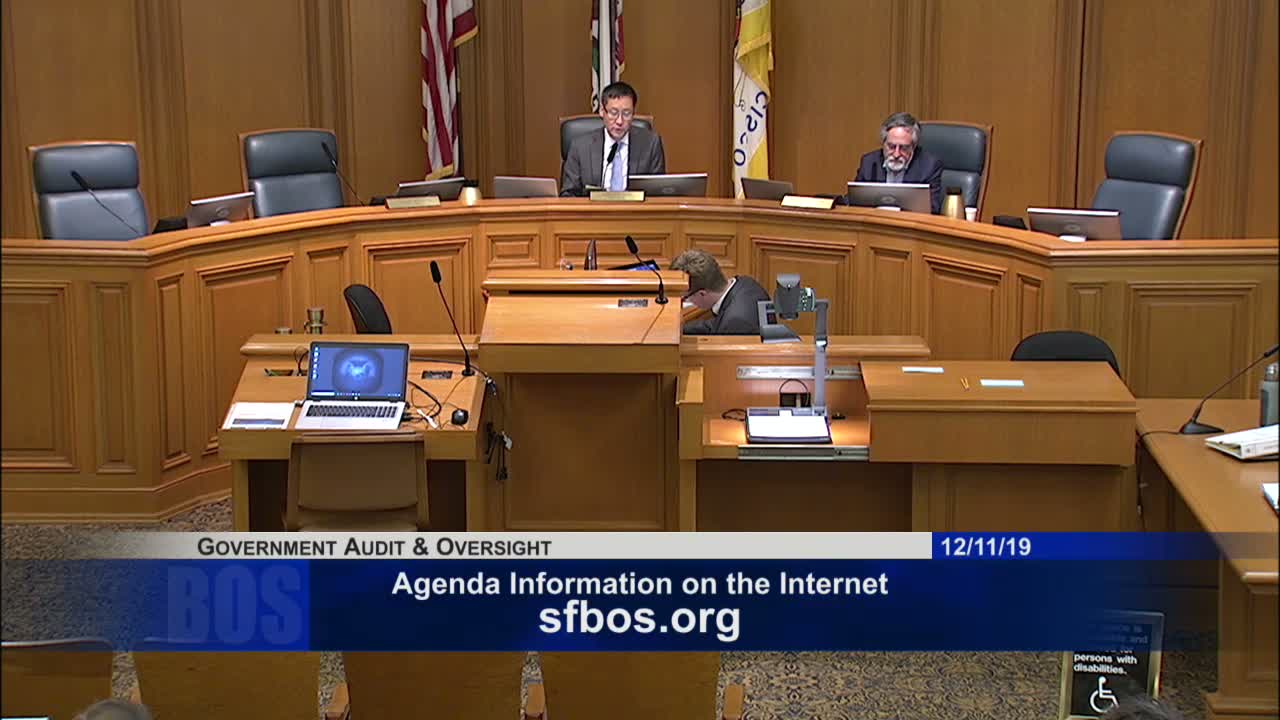
The Government Audit and Oversight Committee voted Dec. 11 to forward a resolution authorizing the Planning Department to apply to ABAG and MTC to confirm and expand Priority Development Areas (PDAs) for Plan Bay Area 2050, sending the item to the full Board with a positive recommendation for the Jan. 14, 2020 meeting.
Supervisor Gordon Marr, who sponsored the resolution, said PDAs help the city "plan for our own future" and emphasized that "PDAs only make cities eligible for additional resources and funding and are not tied to production goals." Marr said jurisdictions can modify or remove PDA designations and that any PDA planning includes community input on specific boundaries.
Planner Joshua Switzky of the Planning Department told the committee he "would be happy to engage with all the supervisors" and with constituents and meetings in affected districts, and described PDAs as a "Bay Area specific voluntary framework" used primarily to access regional planning and transportation funding. "Most of it is transportation funding that comes from the state or the federal government," Switzky said, and regionally it is distributed by MTC and ABAG.
Residents at public comment raised concerns about outreach and potential displacement. Eileen Bogan of the Coalition for San Francisco Neighborhoods cited an ABAG slide and the UC Berkeley Urban Displacement Project finding that "44% of the land area within existing PDAs is defined as at risk of gentrification or displacement," and asked who submitted letters of interest and whether community process occurred before designation. Erica Zweig, a longtime Outer Sunset resident, urged excluding coastal blocks from PDA boundaries because of climate risk. Georgia Shudish (D8) said proposed expansions up Church toward Noe Street resembled SB 50–style upzoning and raised demolition and "monster homes" concerns.
After public testimony and staff responses, the committee agreed to send the PDA resolution to the full Board with a recommendation to schedule the item for the Jan. 14, 2020 meeting to allow additional outreach and district-level engagement. The motion was made and approved "without objection." Planning staff committed to working with supervisors representing districts that include proposed PDAs to provide clear information and solicit community feedback ahead of the Board hearing.
The committee’s action does not change zoning or create an obligation to produce housing; according to Planning staff and the sponsor, PDAs are a voluntary regional designation to prioritize planning and to make jurisdictions eligible for certain regional funding programs.