Get Full Government Meeting Transcripts, Videos, & Alerts Forever!
Get email alerts on the Nonprofit Displacement topic
No spam. Unsubscribe anytime.
City program has awarded $2.1M to nonprofits; officials urge continued funding to prevent displacement
Summary
City officials and the Northern California Community Loan Fund reported that the $4.5 million Nonprofit Displacement Mitigation Program has awarded $2.1 million in grants to 35 organizations and provided technical assistance to more than 50 nonprofits; presenters and nonprofit leaders urged baseline and extended funding to sustain results.
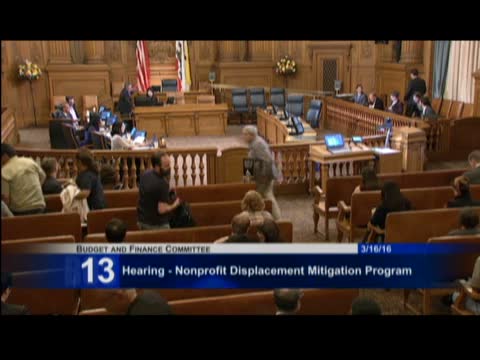
Supervisor Jane Kim convened a hearing to review initial findings from the Nonprofit Displacement Mitigation Program. Brian Chu (Mayor’s Office of Housing & Community Development), Tom DeCaney (Arts Commission) and representatives from the Northern California Community Loan Fund (NCCLF) described implementation and outcomes since the Board set aside roughly $4.5 million for nonprofit mitigation in 2014.
Program results: Presenters reported that $2.1 million in financial assistance grants have been awarded to 35 organizations (12 arts/culture and 23 social service organizations), technical assistance reached over 50 nonprofits, and 40 organizations secured leases of three years or more after entering the program. The NCCLF presented case studies: the Roxy Theatre negotiated a lease and tenant improvements with grant and TA support; Tandem Partners found a larger, more appropriate site in Bayview Hunters Point; Larkin Street Youth Services secured a 15-year lease with $100,000 in assistance.
Survey evidence: Harder & Company presented findings from a Bay Area survey of ~500 nonprofit respondents; 72% of organizations with at least one San Francisco location expect they will have to address relocation within two years, and cost pressures are the predominant reason for potential moves. Respondents operate over 800 unique spaces across the region; about two-thirds of respondents exclusively rent their spaces.
Public comment: More than twenty nonprofit leaders and advocates testified in support of continuing and expanding the program. Many described the NCCLF’s technical assistance as decisive in enabling negotiations, lease conversions and capital planning. Speakers urged baseline appropriations and recommended long-term strategies including acquisition and creation of nonprofit-dedicated space.
Next steps: Staff outlined remaining seed grants in April 2016, a final round of financial assistance in September 2016, a white paper on creating a real-estate holding entity for social service organizations in summer 2016, and technical assistance continuing through a contract that runs until October 2017. Presenters estimated an additional ~$2M in financial assistance would help pipeline organizations through mid‑2018.