Get Full Government Meeting Transcripts, Videos, & Alerts Forever!
Get email alerts on the City Finances topic
No spam. Unsubscribe anytime.
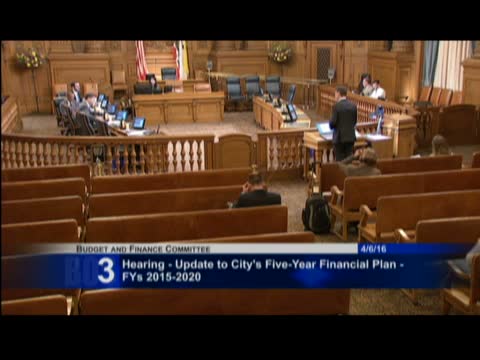
City offices report improved shortfall but warn of large longer-term gaps
Summary
Comptroller Ben Rosenfield and the mayor—s budget office told the Budget & Finance Committee the two-year shortfall improved to about $250 million from $350 million, driven by revenue gains and property-tax revisions, but pension losses and rising personnel costs push larger deficits in later years.
Ben Rosenfield, San Francisco—s comptroller, told the Board of Supervisors— Budget & Finance Committee that the city—s joint five‑year financial update shows improvement in the near term but worsening gaps later in the forecast. "We project a $250,000,000 shortfall during the next two years as opposed to the $350,000,000 we expected in November," Rosenfield said, citing stronger current‑year revenue and a revision to the property‑tax forecast.
The report breaks the two‑year problem into an estimated roughly $86 million shortfall in year one and about $160 million in year two, Rosenfield said. He cautioned that longer‑run figures are more alarming: the forecast shows about a $555 million shortfall in year three and $690 million in year four, driven mainly by higher employee and pension costs and slower revenue growth.
Rosenfield flagged a 5 percent decline in pension fund market gains through February, below the assumed 7.5 percent return, which increases employer contributions. He also described a recession scenario modeled on prior downturns that could widen the gap by roughly $680 million compared with the baseline.
Melissa Whitehouse, acting budget director in the mayor—s office, reviewed expenditure assumptions behind the forecast and noted that recent CPI and negotiated raises increase future personnel costs. She told the committee the mayor—s office and departments are still refining assumptions and that the update is a planning document, not a final budget.
The presentations emphasized contingency planning: the controller and mayor—s budget staff urged the board to consider how to address supplemental requests and contract negotiations in the months before the June budget deadline. Rosenfield and Whitehouse answered supervisors— questions about the drivers of the revisions and the timing of future hearings.