Get Full Government Meeting Transcripts, Videos, & Alerts Forever!
Get email alerts on the Public Health And Safety Bond topic
No spam. Unsubscribe anytime.
Supervisors Continue $350 Million Public Health and Safety Bond After Presentation and Extensive Public Comment
Summary
The Budget & Finance Committee continued consideration of a $350 million public health and safety general obligation bond after presentations on hospital seismic work, community health centers, ambulance facilities, fire station upgrades and homeless shelter improvements and extensive public testimony; staff outlined fiscal impacts and funding trade-offs.
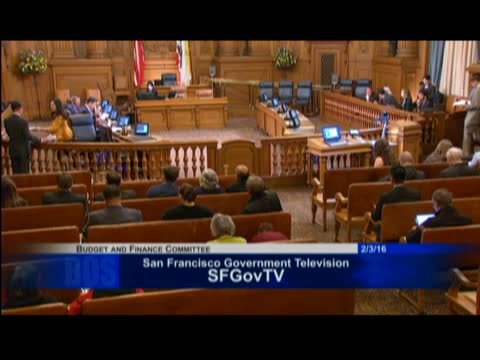
The San Francisco Board of Supervisors Budget and Finance Committee on Feb. 3 heard detailed presentations and public testimony on a proposed $350 million Public Health and Safety general obligation bond and agreed to continue formal action to a special meeting while final amendment language is prepared.
Brian Strong, director of Capital Planning, described the bond as focused on three core areas: seismic and reconfiguration work for Building 5 at Zuckerberg San Francisco General Hospital, expanded investments in Department of Public Health community clinics (including a $30 million Southeast Health Center project plus $20 million for other clinics), and public safety facilities including a proposed $44 million ambulance deployment facility and $14 million for neighborhood fire station upgrades. "The bond is a $350,000,000 bond. It's gonna make improvements to vital city facilities, protect public health and safety," Strong said.
Barbara Garcia, director of Public Health, told the committee the hospital component would stabilize a 1970s-era building and create a centralized ambulatory program that she said could handle nearly 600,000 visits annually while preserving the city's psychiatric emergency services. "This will provide an important safety process for that particular service," Garcia said, outlining a $222 million hospital budget and a construction schedule through 2019 for major projects.
The Fire Department and nonprofit and provider witnesses described operational needs the bond would address. The fire chief and union leaders urged approval of the ambulance deployment facility, arguing it would speed ambulance restocking and improve seismic resilience. Tom O'Connor, president of the San Francisco Firefighters, described the current deployment site as an "unreinforced warehouse" and urged approval of $44 million for a new facility and $14 million for station improvements.
Dozens of public commenters voiced support, including hospital clinicians and nonprofit shelter operators who highlighted deteriorating elevators, roofs and other shelter infrastructure, and health advocates urging investment in integrated primary and behavioral health services. Several small property owners and retirees opposed the bond, saying higher property taxes would worsen affordability for vulnerable households.
Harvey Rose, the board's budget analyst, briefed the committee on fiscal impacts, noting the bond principal of $350 million plus interest yields an estimated $603,999,767 in total debt service over roughly 20 years and average annual debt service of about $27.45 million. Rose estimated the average annual additional property tax for a single-family owner with $600,000 assessed value at roughly $54.27 after the homeowner exemption, while noting that property tax impacts could be offset as existing GO debt retirements occur.
Supervisors raised procedural and fiscal questions about project selection and funding mechanisms. Supervisor Norman Yee asked why an earlier animal shelter project was removed from the GO bond package; Nadia Sese from the Office of Public Finance explained shifting some work from GO bonds to certificates of participation (COPs) would lower the rating and, under the assumptions used by staff, could increase aggregate financing costs by roughly $40 million over the life of the transaction compared with funding via GO bonds.
The committee accepted a package of technical amendments and the city attorney distributed corrected ordinance language. Committee members agreed to continue formal action on Items 1 and 2 to a special Budget & Finance meeting in order to finalize amendment language and incorporate technical corrections. Chair Mark Farrell said staff would file signed amended versions with the clerk. No formal vote on the bond was taken at the Feb. 3 meeting; the committee proceeded with other agenda items.
What’s next: The committee continued Items 1 and 2 to a special meeting to allow staff to finalize amendments and return the bond ordinance and resolution for further action and a committee recommendation to the full Board of Supervisors.