Get Full Government Meeting Transcripts, Videos, & Alerts Forever!
Get email alerts on the Jttf Grand Jury topic
No spam. Unsubscribe anytime.
Experts and community advocates clash over San Francisco’s ties to FBI Joint Terrorism Task Force
Summary
A civil grand jury report on San Francisco’s nonparticipation in the FBI’s Joint Terrorism Task Force prompted expert testimony and extensive public comment on Oct. 3, 2019, with advocates warning of civil‑rights risks and others arguing the city is safer outside the task force.
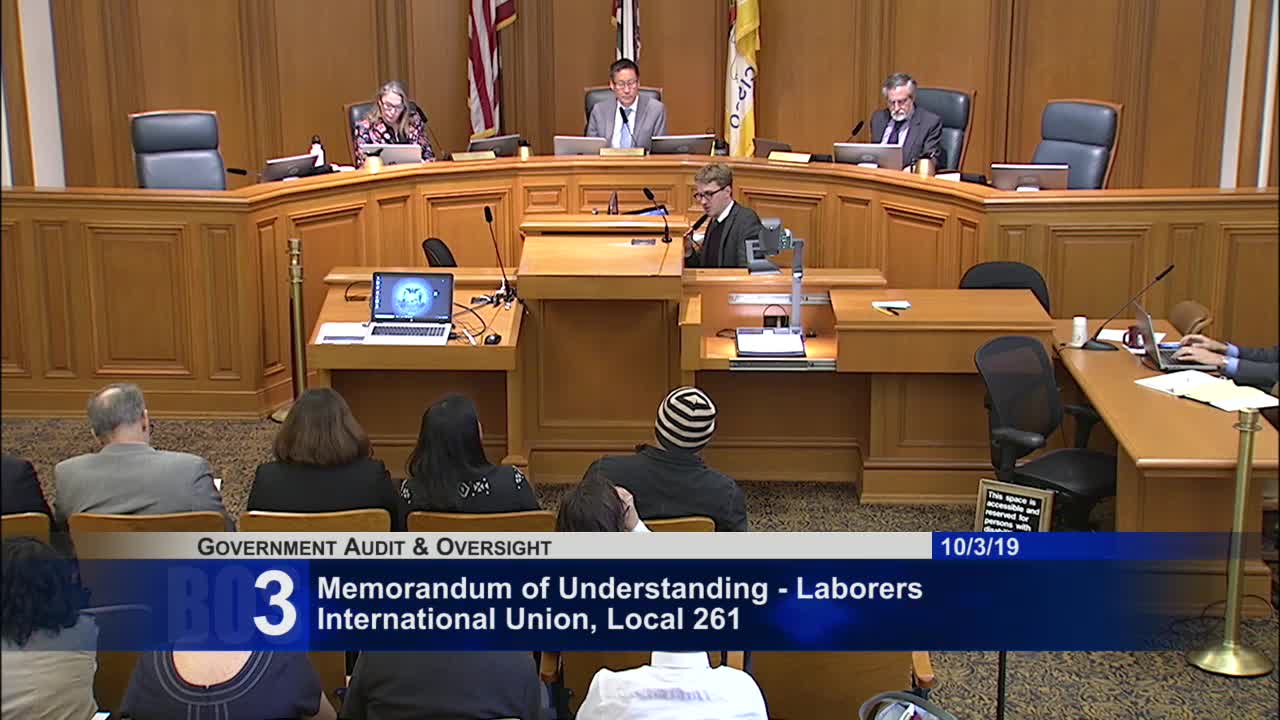
Chair Supervisor Gordon Marr convened the Government Audit and Oversight Committee on Oct. 3, 2019, for a hearing on the 2018–2019 Civil Grand Jury report titled “Joint Terrorism Task Force: Balancing Public Safety with Civil Rights.” The hearing included an outside expert, members of the grand jury, and more than a dozen public comments.
Mike German, a Brennan Center fellow and former FBI special agent, told the committee he had provided written testimony to the grand jury and said the jury’s report "does not capture the scope of the concerns I expressed." German warned that post‑9/11 changes to FBI guidelines have reduced the criminal‑predicate protections that once limited intelligence collection and said, "Participation in JTTFs does not reduce the risk of communication breakdown." He urged that counterterrorism practices be subject to stringent oversight and grounded in constitutional protections.
Rasha Harvey, foreperson of the 2018–2019 civil grand jury, described the panel’s work and said the jury examined why San Francisco suspended its involvement with the JTTF. Janet Andrews, chair of the grand jury’s public safety committee, said the jury is not recommending whether the San Francisco Police Department should rejoin the JTTF; rather, the jury asked that the mayor, police chief, FBI, police commission and civil‑liberties organizations engage in "meaningful dialogue" to resolve outstanding issues.
Community advocates and civil‑liberties groups largely urged caution. Javeria Jamil of the Asian Law Caucus criticized the grand jury report as "riddled with errors and misleading information," cited a 2016 Department of Police Accountability finding that an SFPD JTTF officer violated local policy, and urged that training and compliance issues be addressed before any reengagement. A senior staff attorney from the ACLU of Northern California warned that SFPD cross‑designation as JTTF agents could require immigration‑status checks that conflict with San Francisco’s sanctuary policies and Department Order 5.15.
Other public commenters, including representatives of SEIU Local 87, the Yemeni American Association and the Asian Law Caucus, described a history of FBI surveillance and harassment of Muslim, Arab, Middle Eastern, South Asian and immigrant communities and urged the city to prioritize community trust and oversight. Olga Miranda, president of SEIU Local 87, told the committee the grand jury was "disconnected from the reality and conditions that immigrants live in on a daily basis."
Not all testimony opposed nonparticipation. John Crew, a retired ACLU police‑practice specialist speaking for himself, said the issue is complex but argued that San Francisco is "more safe having made the decision to leave the JTTF," and that information sharing with the FBI has continued through other channels.
Deputy City Attorney John Gibner clarified that this particular grand jury report does not require a Board response; he said supervisors may nonetheless introduce resolutions or legislation on the JTTF if they choose. Chair Marr placed a letter requesting release of an FBI white paper to the public record and the committee filed the hearing without objection.
The hearing produced no committee action to reinstate SFPD participation; it resulted in a public airing of competing views and requests for further transparency and stakeholder meetings as the city considers next steps.