Get Full Government Meeting Transcripts, Videos, & Alerts Forever!
Get email alerts on the Mental Health Housing topic
No spam. Unsubscribe anytime.
Committee forwards ordinance to create cooperative living loan fund to expand communal housing for people with chronic mental illness
Summary
An ordinance to establish a Cooperative Living Opportunities for Mental Health Loan Fund — including a $5 million placeholder from a housing bond — was introduced and recommended to the full Board after presentations from MOHCD and DPH partners and supportive public testimony from behavioral health providers.
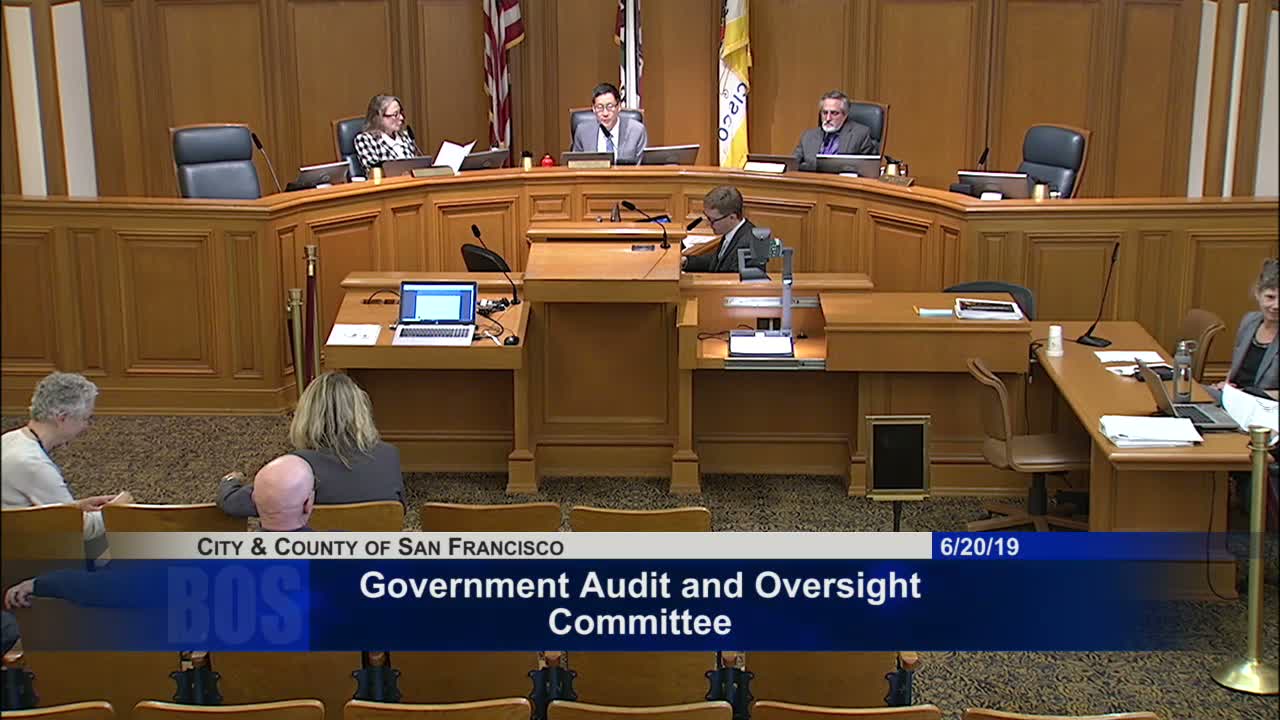
The Government Audit and Oversight Committee reviewed an ordinance to create a Cooperative Living Opportunities for Mental Health Loan Fund designed to finance acquisition of residential properties to operate as scattered-site communal homes for people with chronic mental illness and substance use disorders.
"The legislation will enable nonprofit organizations to acquire apartments and single-family homes to create scattered site non-institutional facilitated communal households in which four or five people with chronic mental illness can share a home assisted with individual and household case management services that are available on call 24/7," Amy Beinart, presenting the item on behalf of Supervisor Ronan, told the committee.
Program design and funding: The ordinance would establish a fund in the Administrative Code that can receive the $5,000,000 the Board previously prioritized in connection with a housing bond, as well as other budget or philanthropic sources. MOHCD’s Kate Hartley said the office expects to collaborate with the Department of Public Health (DPH) and providers to cover programmatic supports; DPH will determine client eligibility and authorize placements. BLA provided an initial cost estimate from DPH: about $73,000 per four-person cooperative household in gross operating cost, with an estimated net cost to DPH of roughly $42,000 after rents and Medi-Cal reimbursements, depending on scale.
Provider testimony: Steve Fields (Progress Foundation) and Richard Heasley (Conard House) described long experience operating cooperative and scattered-site models and urged the committee to forward the ordinance. Fields called the model "a key to reforming and fixing our behavioral health system," and Heasley noted Conard House has operated co-op units in San Francisco since 1963 and argued the model supports community integration and cost-efficiency.
Committee response and next steps: Committee members asked about MOHCD staffing and program scale; MOHCD said staff capacity is limited and that the $5 million in bond funds would likely cover one or two properties in the program’s first year, with staffing and service costs to be addressed through budget processes as the program scales. The committee moved to forward the ordinance to the full Board as a committee report with a recommendation.
Next: The Board of Supervisors will consider the ordinance; MOHCD and DPH will refine cost and staffing assumptions during the budget process and in subsequent program design work.