Get Full Government Meeting Transcripts, Videos, & Alerts Forever!
Get email alerts on the Community Benefit Districts topic
No spam. Unsubscribe anytime.
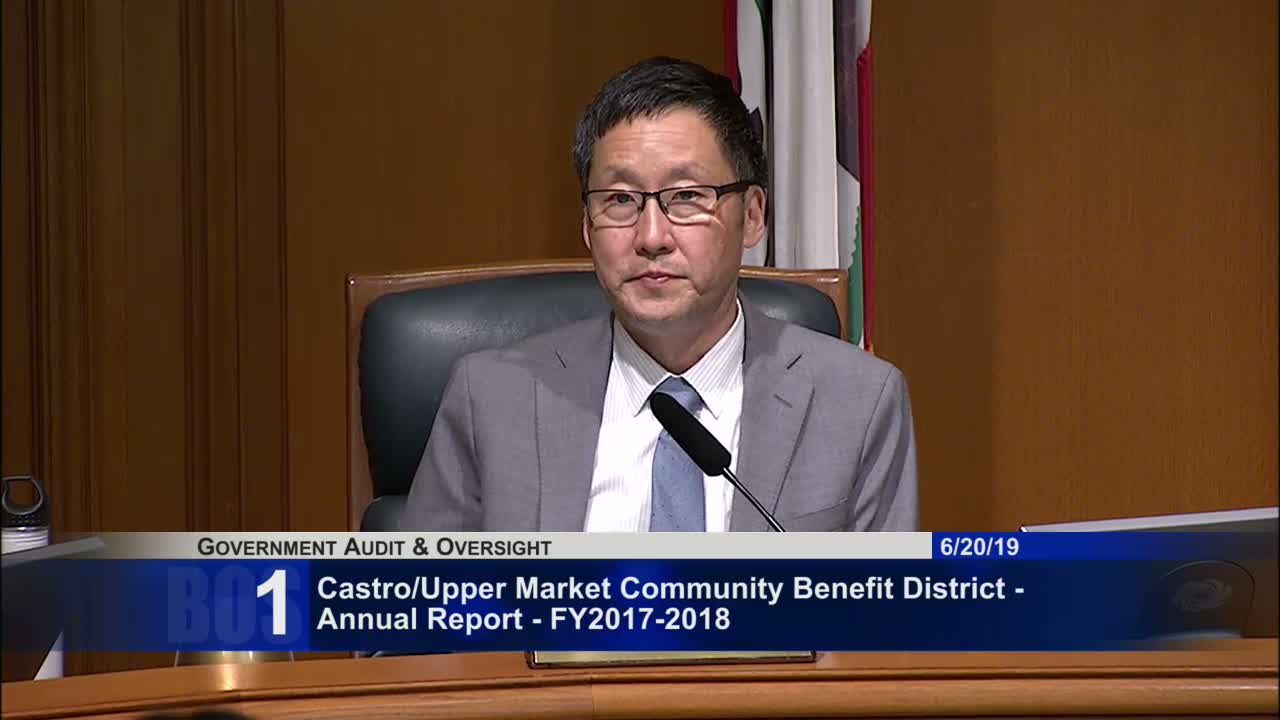
Castro/Upper Market CBD met financial benchmarks but OEWD flagged Brown Act lapse, committee told
Summary
OEWD staff told the Government Audit and Oversight Committee the Castro/Upper Market Community Benefit District met fiscal benchmarks for FY2017–18 and generated nearly half its budget from non-assessment sources, but OEWD found a Brown Act violation tied to board turnover that the district corrected; the committee recommended the report to the full Board.
The Government Audit and Oversight Committee heard that the Castro/Upper Market Community Benefit District met all four OEWD benchmarks for its FY2017–18 annual report but was found to have violated the Brown Act, a staff presentation said.
"They met all benchmarks and requirements," OEWD project specialist Helen Marr told the committee, summarizing OEWD's review of management-plan versus budgets, assessment revenue versus other income, budget-to-actual variances, and disclosure of carryover funds. Marr said the district "was in violation of the Brown Act" and that OEWD believes the lapse was due to governing-board turnover; the district remedied the omission after OEWD contacted it.
Why it matters: Community benefit districts (CBDs) accept assessments from property owners to deliver cleaning, public-safety supplements, marketing and other services in defined commercial areas. OEWD must confirm CBDs follow state and local legal requirements and their own management plans before the Board of Supervisors acts on annual reports and renewals.
OEWD and district representatives outlined operations and metrics for the Castro/Upper Market area. In presentation remarks, the district representative said the CBD’s budget has grown to about $516,000 and that non-assessment revenue now comprises roughly 46.7 percent of total revenue, well above the 5 percent general-benefit guideline.
"At this point, those grants are critical components of our budget," the Castro presenter said, describing recurring grants and philanthropic support that pay for cleaning, security and activation services. She reported the district removed approximately $113,950 of trash last year and recorded about 2,800 instances of what the presenter described as hazardous waste, largely human feces; the district also dispatches a power washer and a cleaning hotline for merchants.
The presenter outlined services the district funds, including a volunteer Castro Ambassadors program, a cleaning contractor, and contracted patrol special police who work with SFPD during evening hours. She also said the CBD supports events and public art and works on retail strategy to address commercial vacancies.
What the committee did: With no questions from supervisors, the committee recommended the OEWD report and the annual report be forwarded to the full Board of Supervisors with a positive recommendation.
Next steps: The CBD is scheduled to sunset on 06/30/2020 and has begun a renewal campaign; OEWD staff said they will continue technical assistance through the renewal process.