Get Full Government Meeting Transcripts, Videos, & Alerts Forever!
Get email alerts on the Sfo Hotel topic
No spam. Unsubscribe anytime.
Budget committee advances bond package and Hyatt management deal for 350‑room hotel at SFO
Summary
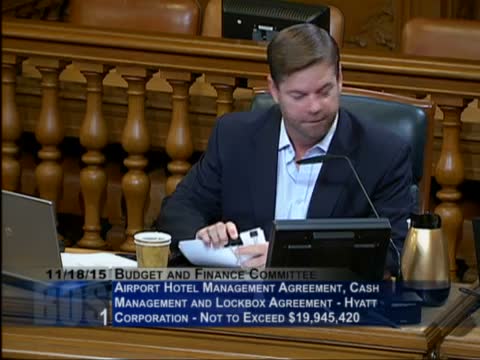
The Budget & Finance Committee voted without objection to send to the full board three related measures enabling a 350‑room Grand Hyatt at San Francisco International Airport: a Hyatt management agreement, two series of airport bonds, and an appropriation ordinance to spend roughly $473 million from bond proceeds and other financing sources.
The San Francisco Budget & Finance Committee on [date] moved to the full Board of Supervisors a three‑part package to build a 350‑room Grand Hyatt on airport property at San Francisco International Airport.
John Martin, director of the San Francisco International Airport, told the committee he was "very pleased to bring this item before you today" and described the project as "a first class hotel on airport property" at the site of the former Hilton. The measures before the committee included a management agreement with Hyatt Corporation, authorization for up to $243 million in Airport Commission Capital Plan bonds and $225 million in special facility bonds, and an ordinance to appropriate approximately $473 million from multiple bond and financing sources to pay for construction.
Martin described the financing structure as tax‑exempt general airport revenue bonds with an interest estimate of about 3.18 percent and said the hotel management agreement proposes nearly $20 million in management fees to Hyatt over a 10‑year term; Hyatt would also provide a $5 million contribution toward construction. Airport staff estimated the city's share of ongoing concession revenues from the hotel at about $1 million per year once operations stabilize.
Several supervisors pressed airport staff on procurement protections and market risk. Supervisor Eric Marr raised questions about the competitive fairness of the RFP and whether nearby Hyatt properties and ongoing upgrades at competing hotels were adequately considered. Martin said the airport received ten proposals, Hyatt scored highest in the evaluation, and the negotiated management agreement includes a contractual protection requiring the airport hotel's average room rate to be at least 35 percent above the nearby Burlingame Hyatt Regency average room rate; if Hyatt fails to maintain that differential the airport may terminate the management agreement and seek a different operator.
Consultants and public commenters offered competing views on market risk. A Cushman & Wakefield consultant retained by Fairmont warned the committee that downturns can sharply reduce hotel net operating income and that owner protection clauses are commonly used to address new supply in downturns. An SFO‑retained hospitality consultant, JLL, presented long‑run occupancy and rate data and said stress tests modeled a severe shock (comparable to 2008) and included reserve mechanisms; JLL projected a substantial premium for a Grand Hyatt at the airport given location and passenger catchment.
Speakers from hotel companies spoke from their commercial perspectives. Pete Sears, president of the Americas for Hyatt Hotels, said Hyatt's on‑airport hotels "perform at a 50% premium" to local competitors and urged approval. Representatives for Fairmont expressed concern about overlapping market segments and recommended careful review of the feasibility and stress‑testing analyses.
The committee's budget analyst summarized key financial figures and risks and recommended approval. The analyst noted the airport can adjust landing/terminal fees under the lease and use agreement to meet operating expenses and debt service if needed. After discussion the committee made a motion and, "without objection," moved items 1–3 to the full Board of Supervisors with a committee recommendation.
What’s next: The measures now go to the full board for consideration. The committee record shows the chair recused himself from items 1–3 for reasons of potential conflict and returned to the dais after the committee acted.
(Reporting note: direct quotes and figures in this article are drawn from the committee transcript and the budget analyst's report presented to the committee.)