Get Full Government Meeting Transcripts, Videos, & Alerts Forever!
Get email alerts on the Telematics Ordinance topic
No spam. Unsubscribe anytime.
Supervisors advance telematics ordinance for public‑safety vehicles, extend compliance date
Summary
After presentations from city fleet staff, police and fire, the committee amended and recommended an ordinance extending telematics (GPS and diagnostics) to public‑safety fleets while keeping GPS location data department‑restricted; the committee set compliance to 06/30/2020 and noted estimated one‑time costs of ~$342,806 and annual maintenance ~$440k–$460k.
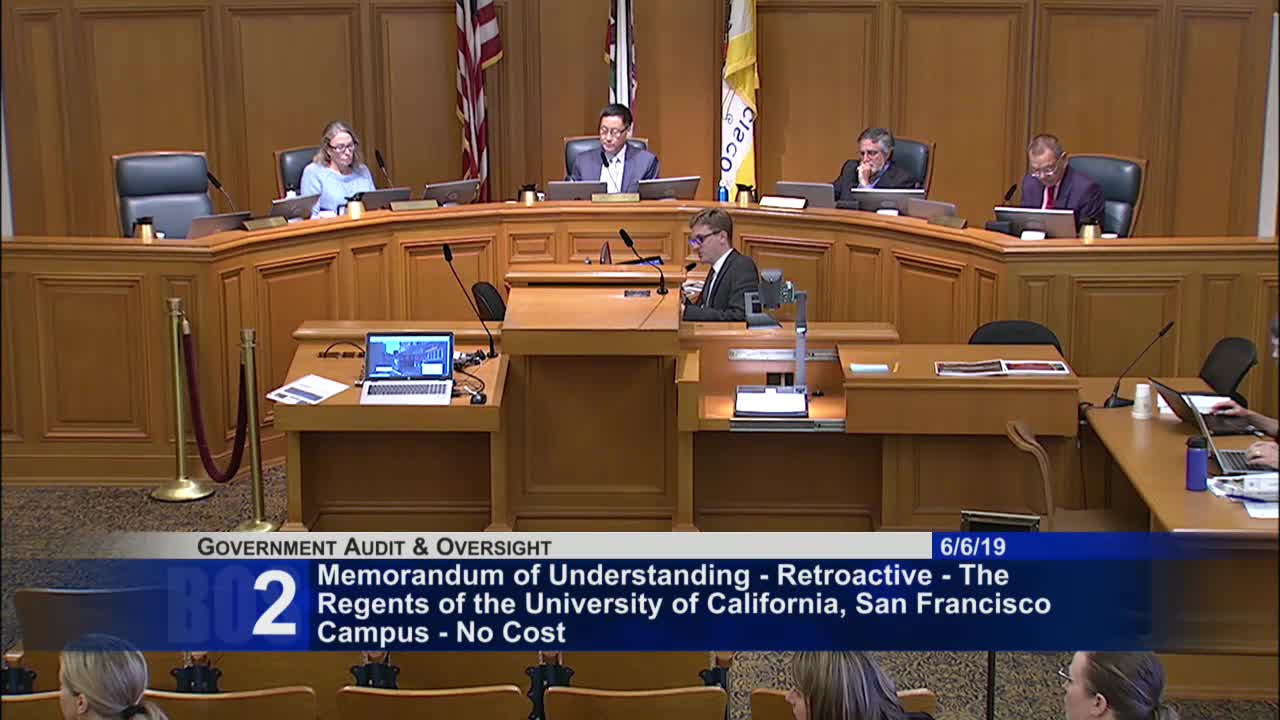
The Government Audit and Oversight Committee on June 6 advanced an ordinance to require telematic vehicle tracking systems in city vehicles used by public safety departments, with safeguards to keep detailed GPS location data within each department and a compliance date amended to June 30, 2020. Supervisor Matt Haney (note: Supervisor Yee sponsored the legislation) and city fleet staff presented technical details and operational experience during a multi‑department briefing.
Adam Nguyen, Finance and Planning Director in the City Administrator's Office, described how telematics devices produce four data groupings: position (regular pings), utilization, safety events (speeding, hard braking) and maintenance diagnostics. Nguyen said the city already has about 4,000 telematics‑equipped vehicles across departments and reported operational benefits including identification and retirement of underutilized vehicles (67 retired in 2018), targeted maintenance from diagnostic codes, and a two‑thirds reduction in speeding incidents after departments received dashboard feedback. He noted that 1,851 vehicles used for law enforcement or investigative services are exempt from the ordinance’s default data‑sharing rules.
Police and fire department presenters supported the expansion. Captain O'Brien (Administrative Bureau, SFPD) said telematics gives supervisors real‑time maps to help manage incidents and perimeter control and that "we are very much in support of telematics." Assistant Deputy Chief Tony Rivera (SFFD support services/fleet) described a successful 2016 fire‑department pilot that enabled remote diagnostics and faster vehicle readiness. Napoleon Campbell (SFPUC) said his agency’s long experience with telematics produced a 64% drop in speeding incidents by March 2019 after sharing dashboard data with supervisors.
Severn Campbell, budget analyst, provided an estimate of fiscal impacts: a one‑time equipment installation cost of approximately $342,806 and annual maintenance costs estimated at $440,000–$460,000; staff recommended a minor amendment to the ordinance's compliance date to allow departments additional time for implementation. The committee approved the amendment and voted to forward the ordinance to the full Board with the compliance date changed to June 30, 2020.
Supporters emphasized officer safety, improved emergency dispatch, preventive maintenance savings and environmental benefits from reduced idling; presenters also described the ordinance’s waiver process and procedures to consult the City Attorney where public records requests intersect with law‑enforcement confidentiality. The committee recorded no objection to advancing the amended ordinance; final Board action remains scheduled in regular legislative review.