Get Full Government Meeting Transcripts, Videos, & Alerts Forever!
Get email alerts on the SOGI Data Collection topic
No spam. Unsubscribe anytime.
San Francisco departments report partial progress on SOGI data; advocates press for trans-specific housing action
Summary
City departments described early steps and persistent gaps in implementing the 2016 ordinance requiring sexual-orientation and gender-identity (SOGI) data collection; advocates and dozens of public commenters urged more targeted housing and shelter solutions for transgender people and demanded accountability and faster implementation.
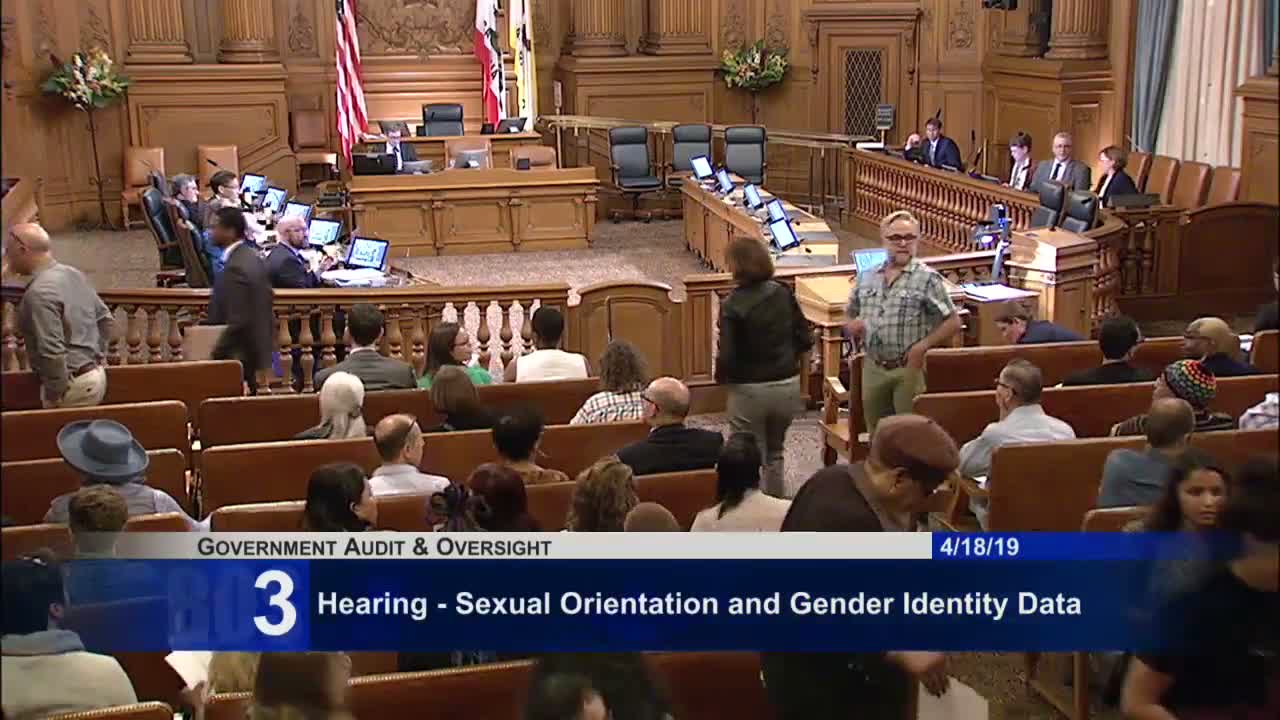
For more than two hours on April 18, seven city departments described their steps to comply with San Francisco—s 2016 ordinance requiring collection and analysis of sexual-orientation and gender-identity (SOGI) data from clients of city-funded health and social services.
Supervisor Rafael Mandelmann, who called the hearing, and former Supervisor Scott Wiener (now a state senator) opened by stressing that collecting SOGI data is a tool to expose disparities and to direct resources, particularly for LGBTQ people who are overrepresented among people experiencing homelessness.
Claire Farley, director of the Office of Transgender Initiatives (OTI), said OTI has provided guidance, helped remove an "assigned at birth" question for nonmedical services, and conducted trainings and listening sessions. Farley said the city finished a pilot year (FY17-18) and departments submitted midyear FY18-19 reports.
Department presenters described a mix of technical and operational obstacles:
- The Department of Homelessness and Supportive Housing (HSH) said it is consolidating legacy systems into a single "1 system" that will be SOGI-compliant; about 40 percent of programs are in the new system now, limiting the completeness of early analysis. HSH reported 4,200 coordinated-entry assessments in fall 2018 but called available SOGI findings "early-stage and non-complete." Abigail Stewart Khan (HSH) said HSH has trained hundreds of staff and nonprofit partners and is finalizing waivers and contract language to add SOGI compliance clauses.
- The Department of Public Health (DPH) said it has added name and pronoun fields and, depending on location, SOGI completion varies widely: some primary-care clinics reported SOGI completion north of 40 percent while psychiatric emergency services were lower. DPH said training touches were high and that Epic—s electronic health record rollout in August should improve data capture and access.
- The Mayor—s Office of Housing and Community Development (MOHCD) reported that inclusion of SOGI questions in grant orientations and application portals produced roughly 11-12 percent of applicants identifying as LGB or questioning in some queues, though numbers were higher in homeless services and organizations that target LGBTQ people.
- Department of Children, Youth and Families (DCYF), Human Services Agency (HSA) and Department of Aging and Adult Services (DAS) described contractor-based collection, translation and training challenges and a DAS dignity-fund equity analysis that found LGBTQ seniors underrepresented in general services and overrepresented in programs specifically targeted to them.
Several departments emphasized that clients may decline to answer and that cultural and language translation issues complicate asking SOGI questions. Departments also cited resource and IT constraints as reasons implementation has been slower than originally scheduled; compliance plans were due in 2017 and the city—s offices acknowledged the rollout had lagged.
Public comment ran long and focused on trans homelessness. More than forty advocates, service providers and people with lived experience urged the city to adopt specific housing proposals promoted by the TransHome SF coalition: rental subsidies for TGNC people at risk of losing housing, organizational development and training to improve inclusion and safety in existing shelters, and dedicated TGNC housing programs for emergency navigation and long-term stability. Witnesses described repeated harassment and violence in general-population shelters and urged that targeted, culturally competent housing and outreach be funded and tracked.
Supervisor Mandelmann said the committee will await the departments— next reports at fiscal-year-end and that another update to the Board is likely in June to assess data improvements and proposed operational steps.
The hearing produced no formal votes; departments were directed to continue work on SOGI reporting, waivers and contract language and to collaborate with OTI and community partners on training and outreach.
Direct quotes in the hearing included: "If we are not being counted, then our community and our needs are invisible," said Senator Scott Wiener; and Claire Farley of OTI said the work "is about more than just compliance with the law" and aims to surface disparities that shape services.
Public commenters repeatedly called for funding and program action to address the housing crisis faced by transgender San Franciscans.