Get Full Government Meeting Transcripts, Videos, & Alerts Forever!
Get email alerts on the Housing Preferences topic
No spam. Unsubscribe anytime.
City report shows limited but targeted use of housing preferences; supervisors push for broader affordability
Summary
The Mayor's Office of Housing and Community Development reported to the Board that three preference programs (certificate of preference, displaced tenant, neighborhood resident) helped place a modest number of households between 2016 and 2018; supervisors stressed outreach, income targeting and more projects in underserved districts.
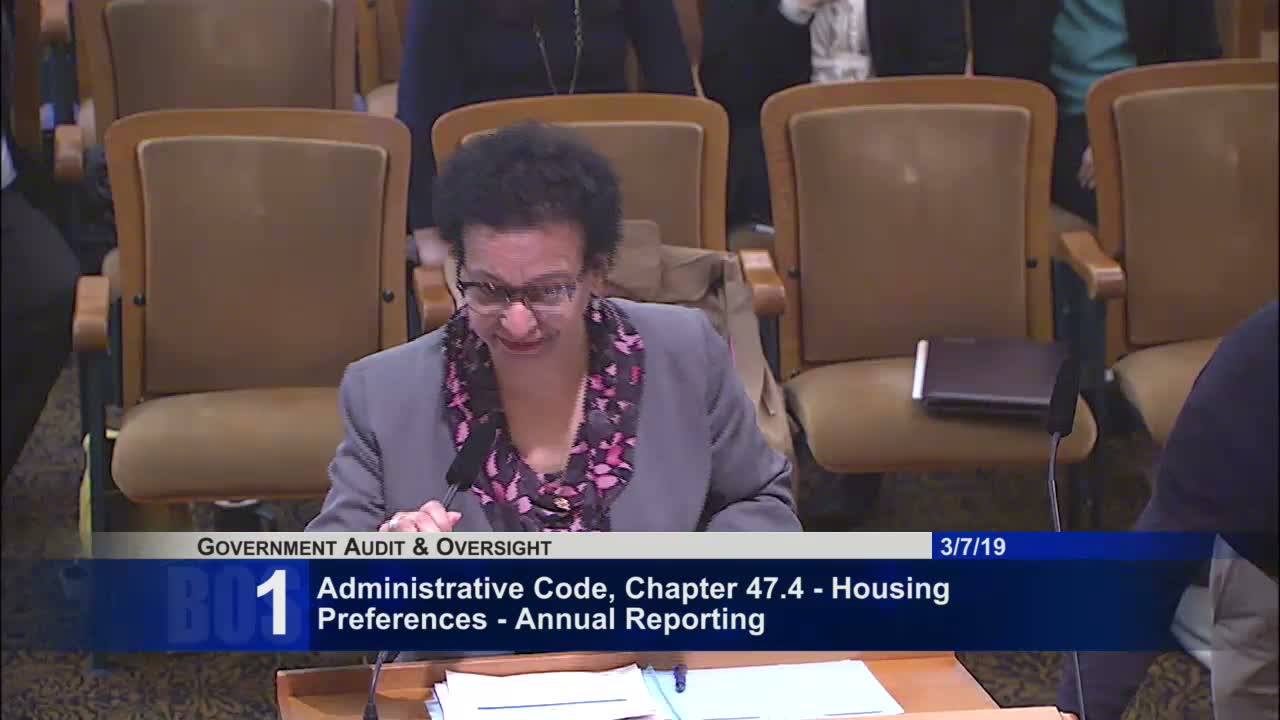
San Francisco ' At the same March 7 committee meeting, the Mayor's Office of Housing and Community Development presented a report on three affordable-housing preference programs covering July 1, 2016'June 30, 2018.
Deputy Director Maria Benjamin said 1,368 units across 47 developments were marketed in the reporting period with 206,894 applications submitted overall. Three preference programs were analyzed: the Certificate of Preference (COP) for people displaced by redevelopment, the Displaced Tenant Housing Preference for tenants evicted from rent-controlled units (including Ellis Act and fire victims), and the Neighborhood Resident Housing Preference (a district or half-mile preference for new developments).
Benjamin said the programs produced a small number of placements during the period: 67 certificate-of-preference holders and 99 displaced-tenant preference households were ultimately housed (the neighborhood preference produced 188 occupant households in newly constructed units where it applied). She noted many applicants did not qualify for units they applied to because of age restrictions, income thresholds or project funding rules; roughly 40% of COP applicants lived outside San Francisco and some applicants are waiting for units that match their needs.
Supervisors pressed the mayor's office on why so many preference applicants were not housed. Benjamin said common reasons included unit-type mismatches (senior units), income disqualification (applicants over or under income limits), and high demand where developer selection processes exhausted general applicant pools before preference categories were reached. The mayor's office said it now sends an email housing alert to roughly 47,000 people and improved building signage and outreach in neighborhoods.
Supervisors also raised federal and state funding constraints on neighborhood preferences. Benjamin said federal funding options had declined and the city had to seek allowances from funding agencies; state bond and tax-credit rules now permit some lower-income targeting, and the mayor's office reported recent tax-credit changes will permit serving households at 30% of area median income in future developments.
Supervisors and the public urged more small-site acquisitions and targeted investments to bring affordable units into underserved neighborhoods on the west side and elsewhere. The committee took the report and asked staff to follow up with demographic breakdowns and to monitor how new bond or tax-credit funds are distributed geographically.