Get Full Government Meeting Transcripts, Videos, & Alerts Forever!
Get email alerts on the Clipper Mou topic
No spam. Unsubscribe anytime.
Committee backs updated Clipper MOU that spreads costs and creates executive board
Summary
The committee approved forwarding a revised memorandum of understanding that extends Clipper governance to 2025, creates an eight‑member executive board and changes the cost‑allocation formula to include roughly $2.1 million in regional credit‑card and banking fees; supervisors said the governance changes are positive but asked about the cost impact on MTA.
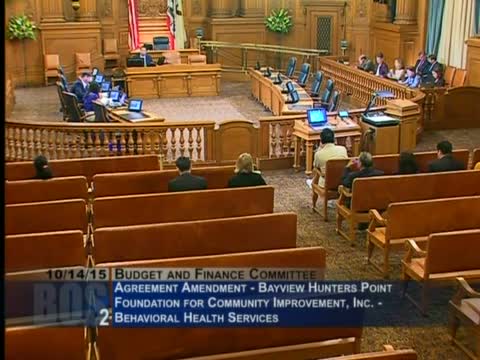
The Budget and Finance Committee on Oct. 14 voted to forward a revised memorandum of understanding among the Metropolitan Transportation Commission (MTC) and Bay Area transit agencies to guide governance and operation of the regional Clipper fare system through June 30, 2025.
Diana Hammonds of the San Francisco Municipal Transportation Agency (SFMTA) said the amendment revises the cost‑allocation formula to incorporate about $2,100,000 in credit‑card and banking fees for Clipper purchases at BART and VTA vending machines and establishes an eight‑member executive board with representatives from transit agencies and MTC. “The MOU includes revisions to the cost allocation formula that will incorporate, for regional allocation, approximately 2,100,000 in credit card and banking fees,” Hammonds said.
The most significant governance change is the new executive board, which will develop performance goals, adopt a biannual work plan and approve matters expected to have substantial fiscal or operating impact—functions that MTC previously exercised alone. Hammonds said Appendix B (the cost‑allocation appendix) is tied to the current Cubic contract and will require returning to the Board of Supervisors when a new vendor contract requires changes to the appendix.
Supervisor Tang asked about an estimated $730,000 increase to the SFMTA share and the contributions for the Clipper executive director position; Hammonds said most of the increase (about $700,000 a year) stems from including BART and VTA vending‑machine fees and that a portion (about $30,000) covers part of the executive director salary previously an MTC cost.
Mr. Rose, the budget analyst, reviewed program administrative cost history and noted the MTA’s estimated share of Clipper administrative costs would rise from $28,100,000 to $30,500,000 over the period 2010–11 through 2014–15 under the proposed amendment. Supervisor Tang moved to forward the resolution with a positive recommendation; the motion passed without objection.
The measure sends the MOU to the full Board; SFMTA and MTC staff said any future vendor changes will trigger additional approvals for appendix revisions.