Get Full Government Meeting Transcripts, Videos, & Alerts Forever!
Get email alerts on the State Legislation Committee topic
No spam. Unsubscribe anytime.
Officials outline how Mayor, Board and State Legislation Committee coordinate San Francisco's lobbying positions
Summary
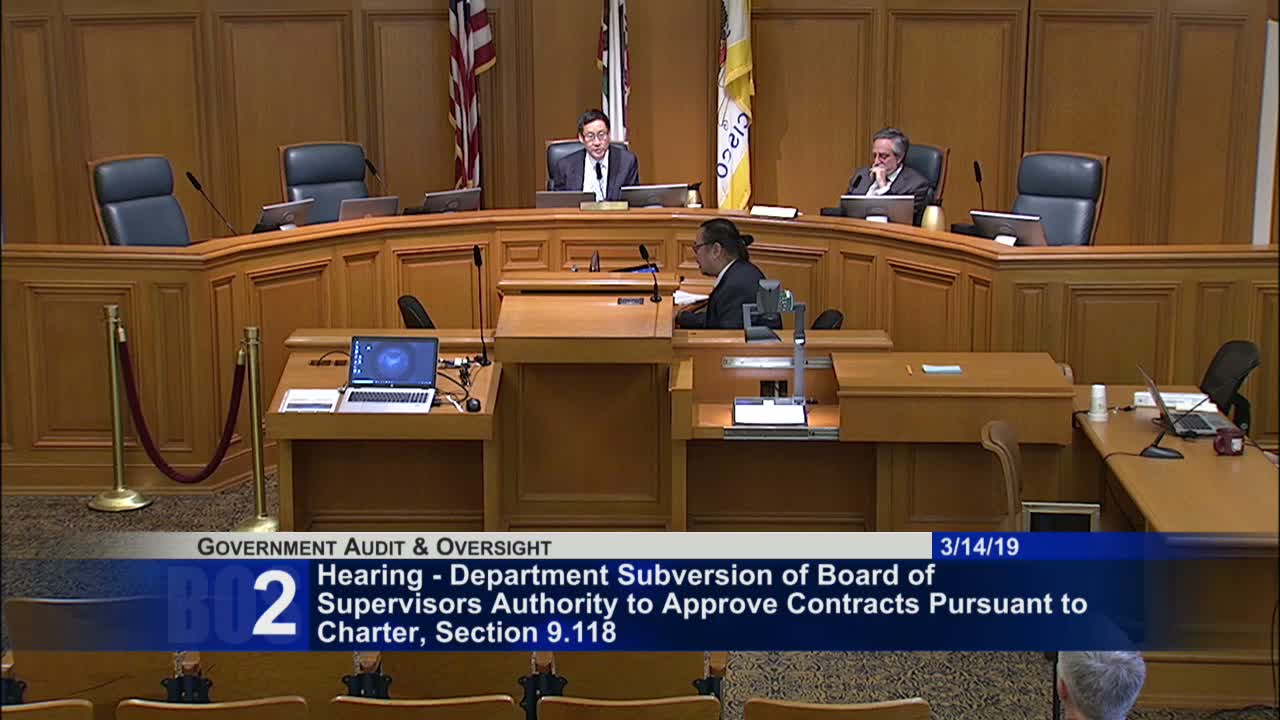
Deputy City Attorney John Givner told the Government Audit and Oversight Committee that the City Charter gives the Mayor authority to coordinate intergovernmental communications while the Board retains policy-setting authority and delegates day-to-day positions to the State Legislation Committee. The committee continued the item so mayor's office staff can attend.
Deputy City Attorney John Givner told the Government Audit and Oversight Committee that the City Charter gives the Mayor authority to coordinate the city's communications with state and federal governments, while the Board of Supervisors retains the reserve power to set policy.
"The Charter provides that the Mayor coordinates all intergovernmental affairs for the city," Givner said in his presentation. He explained that, "if the Board adopts a resolution saying we support AB 1, the Mayor cannot direct the state lobbyist to oppose AB 1." Givner said the Board typically adopts positions by resolution at full board meetings, and the State Legislation Committee (SLC) was created by ordinance to consider and adopt positions between full board meetings.
Givner told members the SLC is a public body subject to the Brown Act and the Sunshine Ordinance and that when the SLC or the Board adopts an official position, the Mayor must conform communications to that policy. He also said that if neither body has set a position, the Mayor has discretion to coordinate communications and direct the city's lobbyists.
Supervisors asked about the SLC's composition and legal advice. Givner described membership that includes mayoral and board representatives and conventionally includes the city attorney, controller, treasurer and assessor. He said the city attorney coordinates positions with the office's executive team and serves as a voting member of the SLC.
Chair Supervisor Gordon Marr and Supervisor Aaron Peskin said the committee wants fuller participation from the Mayor's Office to see how the policy and coordination operate in practice. Supervisor Peskin moved to continue the item to the call of the chair so a mayoral representative could attend; the committee agreed to continue the matter without objection.
The hearing provided a technical explanation of where policy originates and how it is transmitted to the Mayor's Office and to the city's lobbyists, but stopped short of changing any formal practice. The committee closed public comment and continued the matter to the call of the chair so city staff from the Mayor's Office and Human Services Agency can participate at a future date.