Get Full Government Meeting Transcripts, Videos, & Alerts Forever!
Get email alerts on the Performance Management topic
No spam. Unsubscribe anytime.
Civil Grand Jury says San Francisco's performance scorecards need clearer goals and public visibility; mayor and controller largely accept recommendations
Summary
The 2016'17 Civil Grand Jury told the Government Audit and Oversight Committee that San Francisco's performance scorecard framework lacks public awareness, measurable goals on high-priority issues and comparability with other cities. The mayor's and controller's offices said they accept most recommendations; the committee voted to pursue several actions and to review implementation.
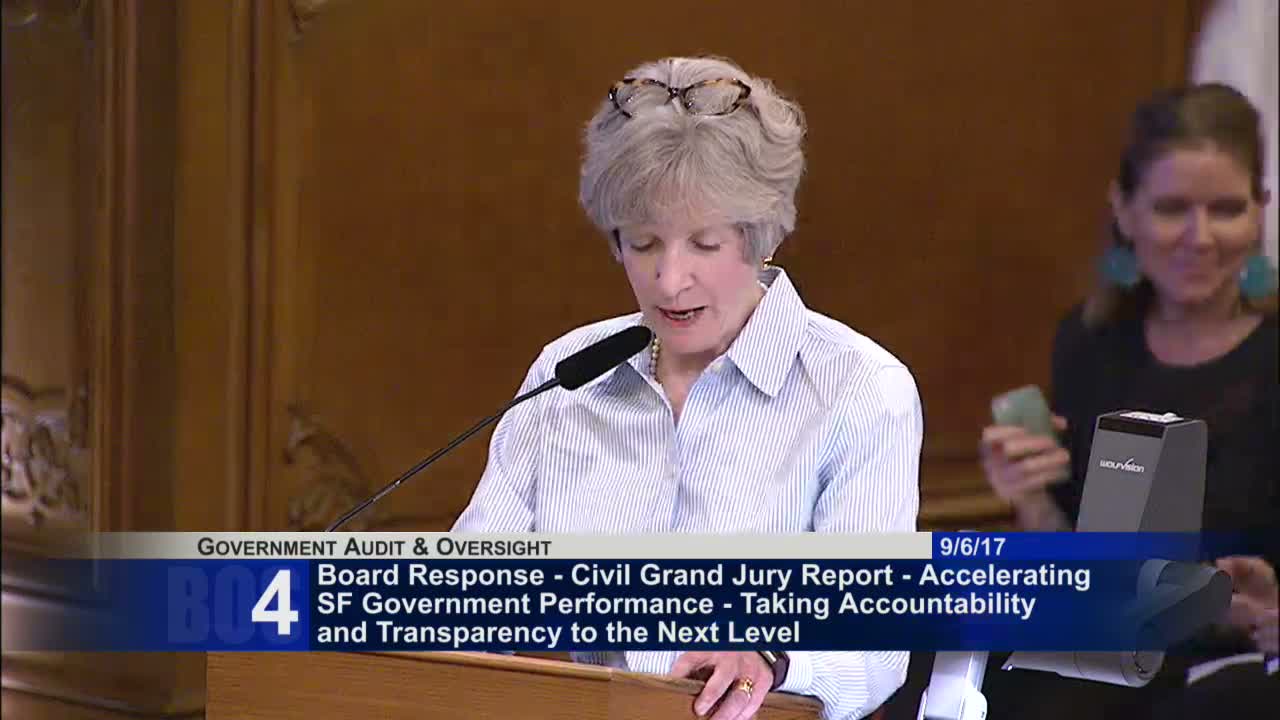
The Government Audit and Oversight Committee heard the 2016'17 Civil Grand Jury report "Accelerating San Francisco Government Performance" on Sept. 5 and took steps to send Board responses and implementation reviews to the mayor's and controller's offices.
Kathy Lowery, foreperson of the civil grand jury, introduced the report and Lawrence Gru, who chaired the jury's committee on performance, summarized the review. Gru said the jury began with a core question: why has a doubling of the city's operating budget over 10 years not produced measurable improvements in areas of major public concern such as homelessness, housing affordability and petty street crime? The jury examined San Francisco's performance scorecard framework, compared it to practices in cities such as Austin and Boston, and issued eight findings and 14 recommendations.
"Distilling it down, basically three things," Gru told the committee: public awareness of the performance framework is low; the most important indicators often lack clear goals or the wrong indicators are used; and other cities are ahead of San Francisco in performance management. He recommended that the city consolidate and highlight 20'30 key indicators, associate goals with measures, and better integrate scorecards into planning and the budget process.
Melissa Whitehouse from the Mayor's Office and Peg Stevenson and Natasha Mihal from the Controller's Office responded. Whitehouse said the mayor's team agrees the issue is important and will work with the Controller to improve public-facing measures and to link scorecards to budget and strategy. The Controller's Office described the Performance Scorecards website (launched early 2016), benchmarking work, the underlying database of more than 1,000 measures and recent additions to the public interface to aid navigation.
Controller staff showed the committee the scorecards'web architecture, explaining that detailed measures, historical data and explanations of responsibility are available on each measure page. Peg Stevenson said the office agrees with many recommendations and will adopt several; she acknowledged that perceptions of the program differ and that some findings are matters of judgment.
Committee members expressed strong support for linking performance goals to the budget process and for highlighting a smaller set of measures for public consumption. The committee recorded a set of responses to the grand jury's findings and recommendations: some findings were agreed with in full, others were agreed with in part, and several recommendations were marked for implementation and follow-up review by GAO within six months.
Next steps: the committee will submit its responses to the presiding judge and will hold follow-up hearings to monitor implementation of the agreed recommendations, including a narrowed set of key performance indicators and quarterly or biannual updates from the Controller's Office.