Get Full Government Meeting Transcripts, Videos, & Alerts Forever!
Get email alerts on the Retirement System topic
No spam. Unsubscribe anytime.
Civil Grand Jury urges clearer pension disclosure; GAO sends report to full board with supervisor amendments
Summary
The Civil Grand Jury told the committee that San Francisco’s retirement system was about 78% funded at FY2016 and that retroactive pension increases have created large immediate liabilities; the committee forwarded the grand jury’s recommendations to the full board and recorded partial disagreements and time‑framed implementation language from Supervisor Peskin.
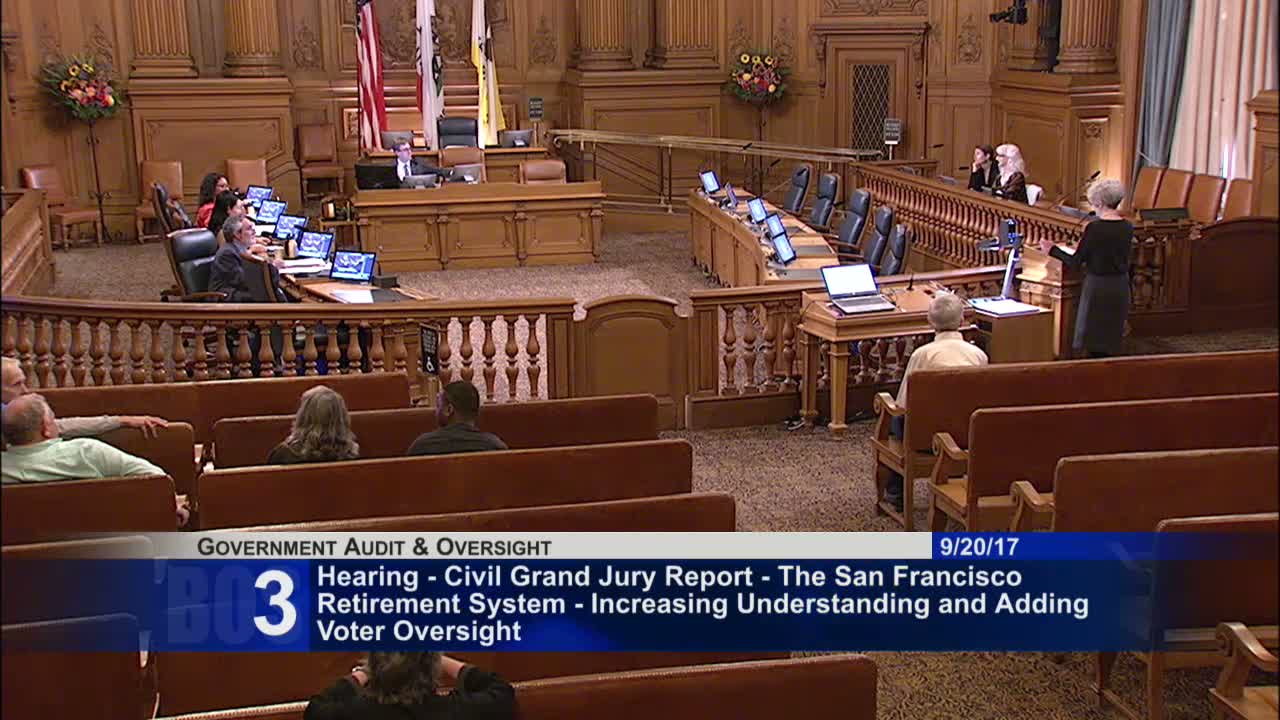
The 2016–2017 Civil Grand Jury told the Government Audit & Oversight Committee that San Francisco’s retirement system faced substantial unfunded liabilities and that voters have not been given clear, accessible descriptions of the long-term costs of pension-related ballot measures.
Kathy Lowery, foreperson of the grand jury, and Chris Bacon, committee lead on the report, summarized findings: at the end of fiscal 2016 the retirement fund was about 78 percent funded, the grand jury estimated an unfunded amount of roughly $5.8 billion and noted that retroactive benefit increases create immediate liabilities that are amortized over decades and charged interest at the system’s assumed discount rate (7.5 percent). The jury recommended clearer, plain-language disclosures in voter materials, creation of a standing oversight committee and more transparent, searchable retirement-system data.
The committee heard responses from the mayor’s budget director and controller representatives and debated recommendations, with Supervisor Peskin offering a packaged response that accepted some recommendations, partially disputed others, and proposed language requiring controller-written, layperson summaries for future retirement-related ballot materials and an annual retirement-system report that explains projected liabilities.
Supervisor Peskin said the larger causes of recent unfunded liabilities include lower-than-expected investment returns, demographic assumption changes, and the 2011 court decision on supplemental cost-of-living adjustments, not solely voter-approved benefit measures between 1996 and 2008. He asked that the board formally state partial disagreement with some of the grand jury’s characterizations while committing to better disclosure and to revisit governance questions if new legal changes occur.
The committee voted to forward the grand jury report and its recommended responses to the full Board of Supervisors and to continue some related work in committee for follow-up implementation time frames.
Why it matters: The retirement system’s funding and governance affect long-term city budgets and intergenerational equity; clearer public disclosures could affect future ballot measures and fiscal decision-making.
Next steps: The GAO Committee forwarded the report with recommendations and indicated it will track implementation schedules; supervisors and the mayor’s office signaled interest in improved public summaries, searchable data publication and consideration of a standing oversight body.