Get Full Government Meeting Transcripts, Videos, & Alerts Forever!
Get email alerts on the Technology Audit topic
No spam. Unsubscribe anytime.
Audit committee reviews Department of Technology performance audit; supervisors press for IT governance and lower license costs
Summary
The Budget and Legislative Analyst presented findings on the Department of Technology's contracting, billing, PMO and staffing; DT Director Linda Gurel outlined corrective actions and supervisors pressed for a long-term IT governance plan and exploration of open-source alternatives to expensive licensed software.
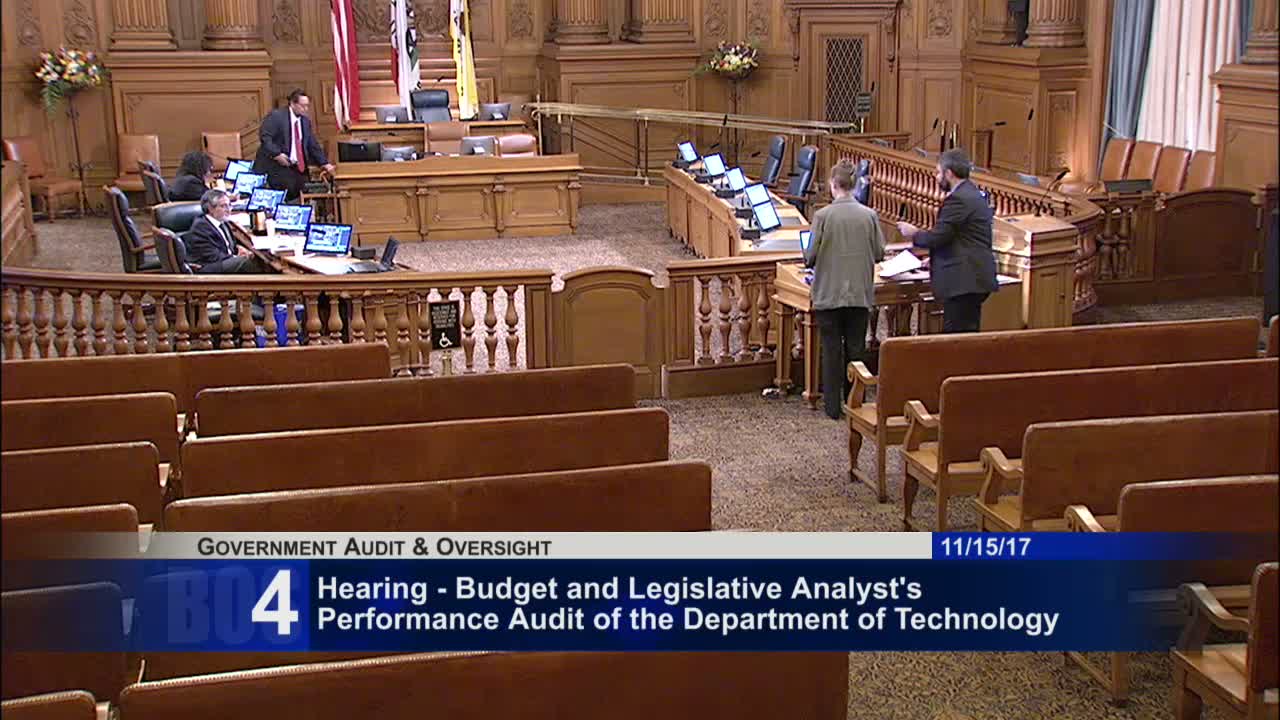
The Government Audit and Oversight Committee on Nov. 15 reviewed the Budget and Legislative Analyst's performance audit of the Department of Technology (DT), focusing on financial controls, contracting, service-level management and the PMO's role.
Nick Menard, project manager for the Budget Analyst, summarized findings across six areas. He said DT had no audit findings on information security or strategic planning because those topics saw improvements during the audit, but he highlighted problems in financial management and contracting: baseline service charges were not defined, causing uneven cost recovery and cross-subsidies; less than half of project-based work orders included documentation of scope, schedule and basis for cost; and DT had not centrally tracked contract expiration and remaining spending authority until late 2016 (the BLA found multiple active contracts that had technically expired). Menard also reported PMO role ambiguity and limited access to project budget and expenditure information, which impaired consistent status reporting.
New DT Director Linda Gurel described steps DT has taken in her first 100 days: rolling out ServiceNow for service management, drafting interdepartmental service-level agreements and templates (including line-item budgets and timelines for work orders), procurement training with the Controller's Office and City Attorney, invoice-review procedures, and color-coded project dashboards. She said DT "has acted on all of the recommendations from the audit" and emphasized staffing and process changes to improve transparency and customer service.
Supervisors pressed DT on reducing reliance on paid licensed software and on creating an IT-governance framework that evaluates total cost of ownership and integration requirements. Chair Jane Kim and others noted the city already uses open-source software (Drupal for the city's web presence) but asked for a longer-term plan to assess when and how open-source alternatives could replace licensed systems while meeting security and integration requirements. Gurel said open-source options are under consideration but cautioned that total cost of ownership and integration with systems that must meet CJIS/security requirements should guide decisions.
The committee accepted the audit and filed the report; Supervisor Peskin moved to file the item and the committee did so without recorded opposition.
What happens next: DT will continue implementing the audit's recommendations and the committee asked for ongoing status reporting to track contract management, work-order documentation and PMO improvements.