Get Full Government Meeting Transcripts, Videos, & Alerts Forever!
Get email alerts on the Heat Response topic
No spam. Unsubscribe anytime.
City officials defend heat‑wave response as departments and nonprofits mobilized; supervisors press for faster outreach to vulnerable residents
Summary
Departments said the Department of Public Health led a unified command during the record September heat wave, mutual aid was invoked for ambulance support, and cooling centers and pool access were opened. Supervisors criticized the timing and the reach of outreach to seniors and non‑English speakers; dispatchers described severe stress from doubled 911 call volumes.
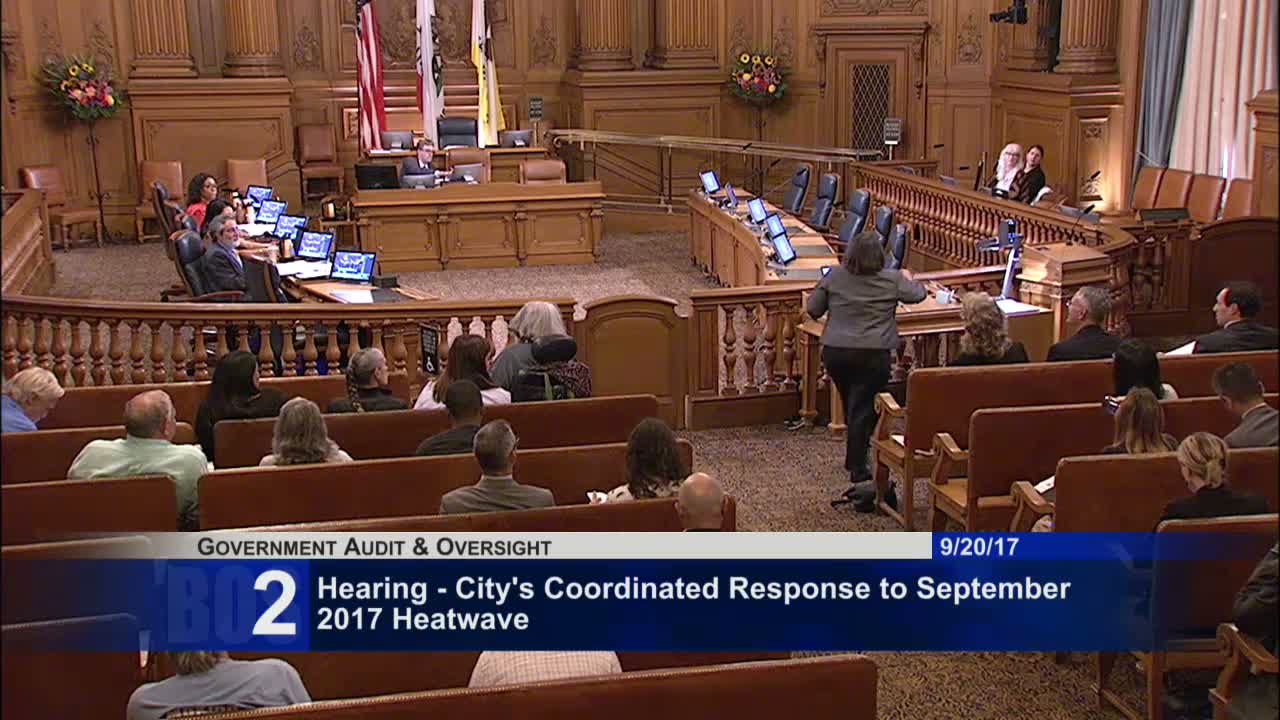
San Francisco department leaders and nonprofit partners told the Government Audit & Oversight Committee that the response to the record-breaking Labor Day‑weekend heat wave was coordinated but left room for improvement in timing, outreach to vulnerable populations and translation.
“Emergency response structures were activated and we operated in a unified command,” said Barbara Garcia of the Department of Public Health, describing hospital coordination, outreach to community providers and deployment of high-heat protocols. Dr. Navina Baba, DPH preparedness lead, said the city added private and county ambulance resources before invoking strike teams and mutual aid when call volumes continued to climb.
The Department of Emergency Management (DEM) and Fire Department said the 911 system absorbed a large surge in calls. Fire Chief Joanne Hayes White praised dispatchers and mutual-aid partners, and said the first-alarm ALS response times were strong given the load; dispatchers later testified that they worked extended shifts and saw multiple code‑3 calls queue while ambulances were unavailable.
The National Weather Service explained the meteorology behind the surprise: an eastward bulge in high pressure prevented the normal onshore cooling breeze, keeping night temperatures unusually high (overnight lows near 75°F) and trapping heat in buildings.
Supervisors and advocates criticized the timing of cooling-center activations and the speed of outreach to seniors, limited-English communities and homeless populations. President Breed and Supervisor Peskin urged the city to expand non-social-media notification methods for people who are not on Twitter or Nextdoor, to inventory air‑conditioned public buildings that could serve as resilient cooling sites, and to translate materials faster. HSH and other departments said the homeless outreach hot team distributed 5,000 bottles of water to about 2,500 people and opened a shelter-based cooling center for people living on the street.
Dispatchers and 911 staff described sustained periods with dozens of pending ambulance requests; one dispatcher asked that frontline dispatchers be included in the September 29 after-action review. Medical staff at Zuckerberg San Francisco General recounted extraordinary clinical surges, including multiple heat-stroke patients brought to the emergency department.
The committee voted to file the item after accepting departmental letters and to require follow-up: an after-action review is scheduled, hot washes have begun in agencies, and DEM said it will work to improve translations, public information and an inventory of air‑conditioned public spaces. Supervisor Peskin thanked departments for their prompt mutual-aid work but said the hearing exposed gaps to fix before future extreme events.
Why it matters: As extreme heat events grow more frequent, the timing of activation, translation and outreach can make the difference between preventable emergency-room visits and saved lives. City officials said they will incorporate lessons into updated heat-response plans and communications protocols.
Next steps: Departments will complete hot-wash reviews, participate in an interagency after-action on September 29, and return to the committee with proposed improvements to outreach, translation and cooling‑site activation triggers.