Get Full Government Meeting Transcripts, Videos, & Alerts Forever!
Get email alerts on the Data Sharing topic
No spam. Unsubscribe anytime.
Supervisors press for governance, timeline and funding to finish Justice data-sharing hub
Summary
After a multi-agency hearing, supervisors urged strengthened governance, a consolidated budget and a timeline to complete Justice's hub-and-spoke data integration; agencies described phased progress, interface limits with the legacy mainframe and the need for more resources for analytics and a permanent program.
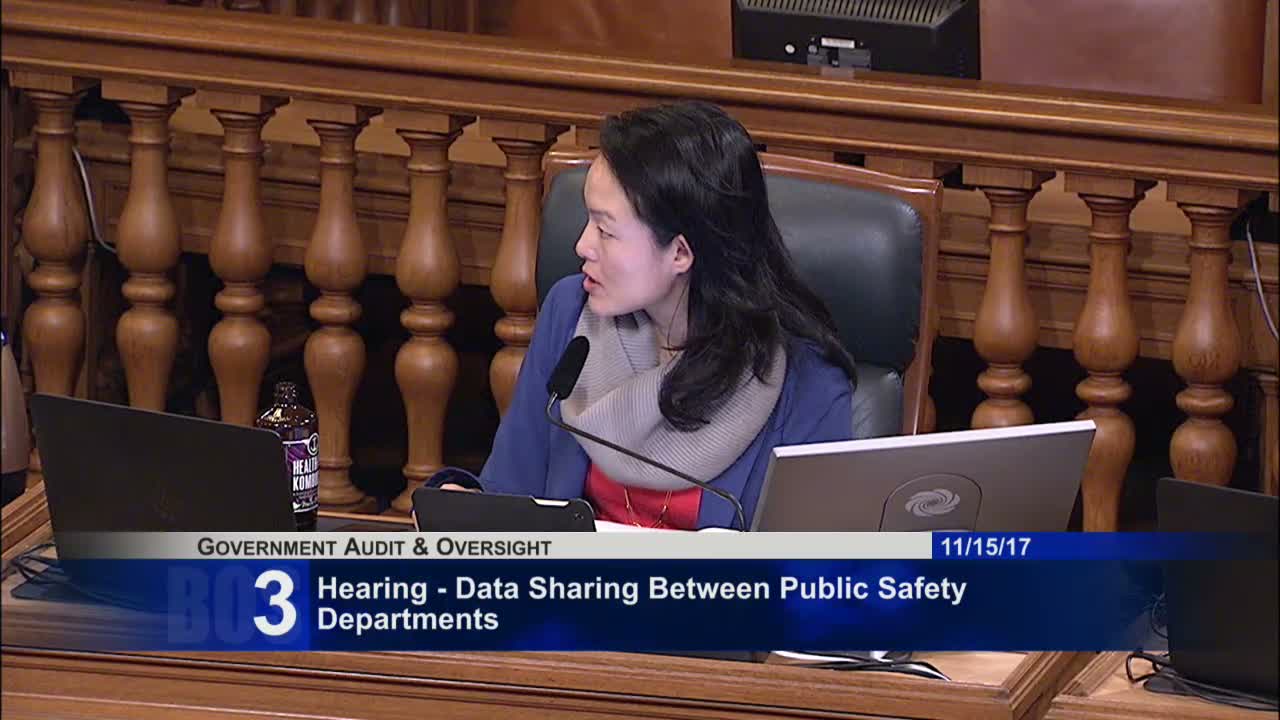
The Government Audit and Oversight Committee devoted the bulk of its Nov. 15 meeting to the Justice Information Tracking System ("Justice"), a two-decade effort to replace the city's legacy court-mainframe and integrate criminal-justice case data across agencies.
Supervisor Norman Yee framed the hearing, saying Justice began in the late 1990s after the murder of Claire Joyce Timbongo highlighted coordination failures. "It seemed ridiculous to me that data was not streamlined in the first place to help expedite cases," Yee said, urging renewed Board attention.
Rob Castellia, Justice project manager in the Office of the City Administrator, described the Justice Hub as an integration tool designed to connect each agency's case-management systems so they can share critical data. He told the committee some feeds to Justice are near real time (for example, the sheriff's jail-management system) while others remain batch or one-way (the District Attorney currently receives a once-per-day update). Castellia said interface constraints with the legacy mainframe remain a bottleneck and that work with the courts and probation is expected in the coming fiscal year to accelerate decommissioning of the old system.
Susan Merritt, SFPD Chief Information Officer, described progress building police enterprise systems (including a Crime Data Warehouse launched in 2011) and said the department finalized an MOU with the District Attorney in 2014 to provide incident data. Merritt emphasized security and access controls: "If we give someone access to Crime Data Warehouse, they see everything," she said, so procedural MOUs govern who receives data via Justice.
Maria McGee, principal analyst in the District Attorney's crime strategies unit, said the data and infrastructure "exist," but offices lack a consolidated reporting capability. "We need to invest in Justice to build a data repository and reporting functionality so that meaningful data is readily available," she told the committee, urging that Justice be made a permanent program with a timeline and budget and that the Justice Governance Council submit quarterly progress reports.
Witnesses and former Justice staff traced governance problems: the original consolidated budget and an executive-sponsorship role were dismantled over time, leaving Justice with limited authority and a small team. Former staff said Justice has never grown beyond roughly six or seven full-time staff dedicated to hub work. Multiple supervisors recommended the city administrator convene the Governance Council and consider restoring centralized budget authority or another stewardship structure to compel consistent participation across agencies.
Public commenters, including neighborhood groups and criminal-justice advocates, urged transparency and public access to outcome metrics: commenters asked for data that connects reports, arrests, prosecutions and convictions so the public and researchers can evaluate programs and disparities.
Committee direction and next steps: Supervisors asked the city administrator to convene the Justice Governance Council to produce a strategic plan, timeline and budget and to return to the committee with progress updates. The committee voted to continue Item 3 to the call of the Chair for follow-up; the motion carried without recorded opposition.
Sources: Opening remarks by Supervisor Norman Yee, presentations by Rob Castellia and Susan Merritt, testimony from Maria McGee, public commenters and committee motions on Nov. 15, 2017.