Get Full Government Meeting Transcripts, Videos, & Alerts Forever!
Get email alerts on the Construction Business Impacts topic
No spam. Unsubscribe anytime.
Controller: Two long construction zones tied to double-digit sales drops; city outlines targeted supports
Summary
A controller analysis found Castro and West Portal corridors experienced statistically significant retailer sales declines (~12–13%) during prolonged construction; departments described outreach and a new OEWD support package including up to $10,000 for directly impacted businesses. Supervisors pressed for faster, cash-based relief and asked the controller to add closure counts to the final report.
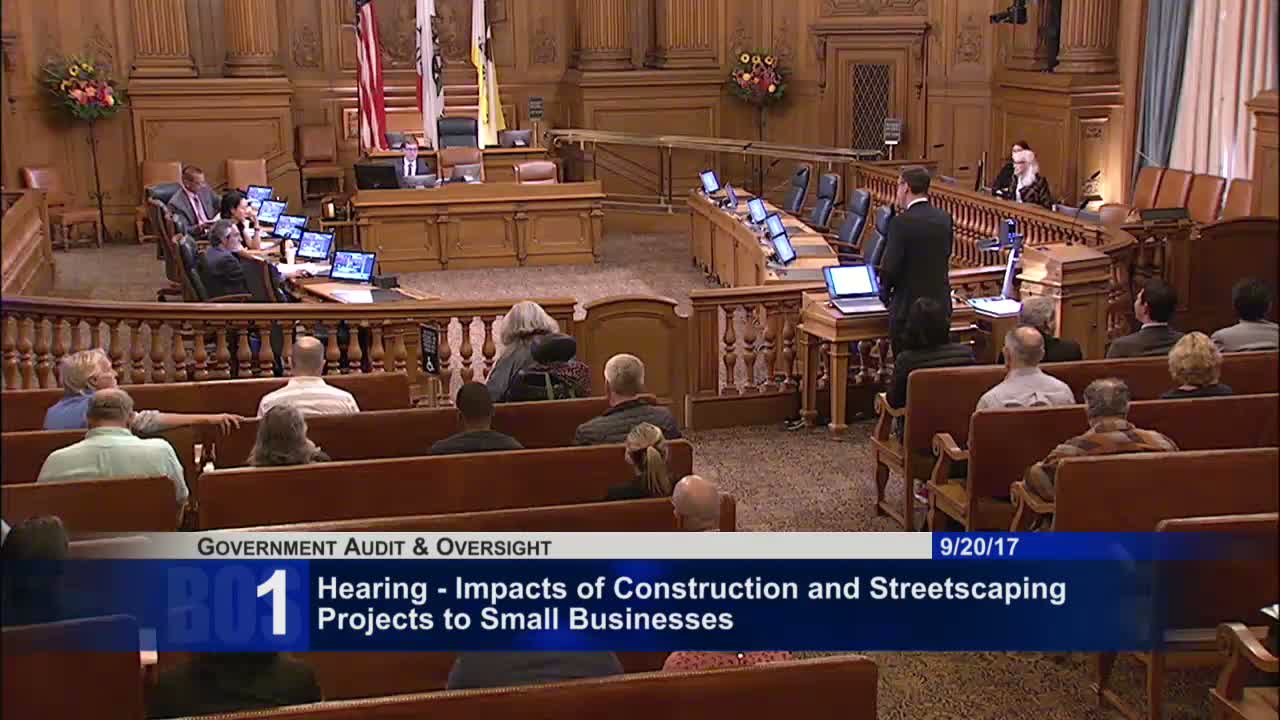
The San Francisco city controller told the Government Audit & Oversight Committee that an interim, business-level analysis of six construction zones found mixed effects on merchants but clear harm where projects lasted longest.
“Two projects with the longest construction periods — West Portal and Castro — show a statistically significant loss of revenue of approximately 12 to 13 percent in each district,” City Controller Ben Rosenfield said, describing the study’s regression methodology and its limits. Rosenfield cautioned that the analysis uses taxable sales as a proxy and therefore underrepresents service-sector firms that do not collect sales tax.
The controller said he reviewed six sample projects and compared businesses in affected corridors with neighborhood benchmarks. In the two longest-duration cases, he said, losses during construction were clear; in four shorter projects, the analysis found “no statistically significant loss of revenue.” He also reported mixed post-construction results: Balboa showed more than 15 percent improvement in the first three years after work ended, while Castro and West Portal had only partly recovered two years after project completion.
City departments outlined measures they use to limit business disruption. John Thomas, deputy director for infrastructure at the Department of Public Works, said the city coordinates projects wherever possible, combining paving, sewer and utility work to “disrupt the street once” and provide long-term benefits. He acknowledged that joint projects tend to take longer and that unforeseen subsurface conditions can extend schedules, and described contractual delay provisions and resident engineers assigned to projects.
Joaquin Torres of the Office of Economic and Workforce Development described the office’s “Open for Business” model and an “enhanced suite” of supports for major-impact corridors, including individualized business advising, corridor marketing, ADA and façade assistance, and — for businesses facing direct impacts six months or longer — directed financial support up to $10,000 to implement action plans.
Small-business leaders and merchants gave the committee vivid accounts of lost revenue, canceled classes and last-minute schedule changes that reduced visibility and foot traffic. Paul Pendergast of the San Francisco Small Business Network said contractor accountability and transparent use of any contractor-assessment funds remain unresolved. Jenny Werba, a class-based business owner affected by Fourth Street subway work, said crews changed sidewalk work times with less than a day’s notice, forcing canceled classes and lost membership revenue.
Supervisors pressed departments for faster, cash-based mitigation, citing models in other cities. Supervisor Norman Yee, who called the hearing, said the city must consider direct grants or loans so legacy businesses can survive months or years of construction. Several supervisors asked the controller to include counts of businesses that closed during the construction periods in his final report; Rosenfield agreed to track closures by project area and to analyze impacts by business type.
The committee did not adopt policy at the session. Supervisor Yee asked that the item be continued to the call of the chair for follow-up with departments; Chair Kim and the committee approved the continuation without opposition. The controller said he will present final findings when the work is complete.
Why it matters: Many of San Francisco’s commercial corridors are undergoing simultaneous, multiagency capital projects. Council members and small-business leaders said that without clearer notification, stronger contractor enforcement and meaningful cash support, long-term projects risk shuttering legacy merchants who operate on slim profit margins.
Next steps: The controller will finalize his report with additional analysis (including closures) and departments, led by OEWD and Public Works, will continue refining outreach, parking coordination and mitigation plans. The committee will hold the item to the call of the chair for follow-up.