Get Full Government Meeting Transcripts, Videos, & Alerts Forever!
Get email alerts on the Mills Act topic
No spam. Unsubscribe anytime.
Committee advances some Mills Act contracts, continues others and flags enforcement history
Summary
The GAO Committee advanced three Mills Act items with conditions: it continued three items for further review of violations, recommended two items to the full Board, recommended one item (627 Waller) with a 10‑year limitation to be worked out, and tabled one item; supervisors pressed staff on valuation methods, equity and eviction histories.
The Government Audit & Oversight Committee reviewed a package of Mills Act historic‑property contract applications and divided the batch for follow‑up, forwarding, and delay.
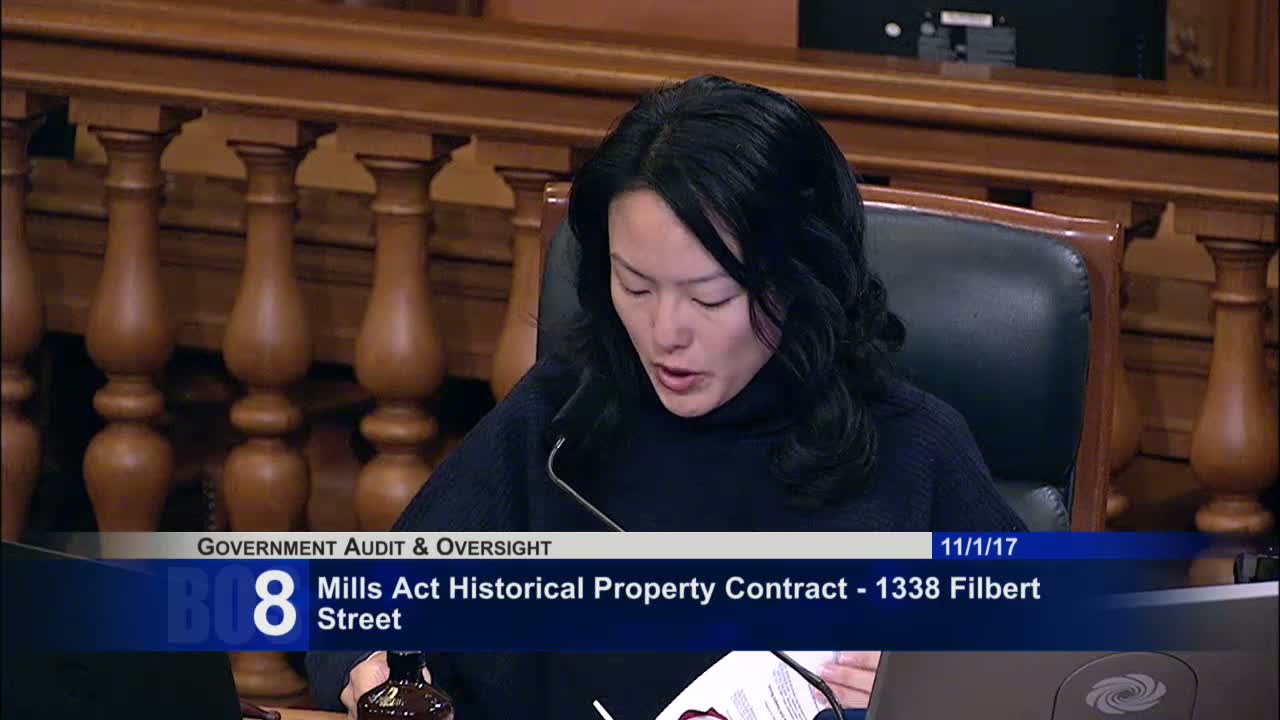
Clerk and Planning Department staff presented applications for properties at multiple addresses (215 & 229 Haight; 56 Potomac; 60–62 Carmelita; 101 Vallejo; 627 Waller; 940 Grove; 1338 Filbert) under Administrative Code chapter 71. Tim Frey, historic preservation officer, explained Mills Act eligibility, the maintenance/rehabilitation plan requirement and the local review process; the assessor's office described three valuation approaches (factored base year, market approach, restricted income approach) and said the office uses the lowest value of the three to calculate the Mills Act reduction.
Supervisors pressed staff on several issues: how tax savings relate to the value of improvements (staff said there is not a direct dollar‑for‑dollar nexus); the program's caps and the board's discretion to waive caps for properties worth more than $3,000,000 (residential) or $5,000,000 (commercial); and a procedural lapse in which Planning did not flag an outstanding enforcement case for 973 Market when presenting the list to the committee. Planning staff acknowledged the oversight and said the enforcement matter was resolved after staff pursued abatement.
The committee heard owners and applicants in support of projects (notably 627 Waller), and supervisors debated policy options including limiting Mills Act contracts to fixed 10‑year terms rather than indefinite rolling renewals, and whether high percentage reductions (examples cited up to 62.26%) were appropriate for work that was already completed.
After discussion, the committee adopted a combined motion: continue items 2, 3 and 4 to the call of the chair for further review (including verification of enforcement status); forward items 5 and 7 with a positive recommendation to the Board of Supervisors; move item 6 (627 Waller) forward with a recommendation but limit it to a 10‑year contract (mechanism to be worked out by the city attorney); and table item 8. The committee recorded a 3‑0 vote in favor of the package motion. Staff agreed to provide the detailed assessor valuations and case documentation requested by supervisors.