Get Full Government Meeting Transcripts, Videos, & Alerts Forever!
Get email alerts on the Five Year Financial Plan topic
No spam. Unsubscribe anytime.
Budget committee reviews five-year financial plan and new recession scenario
Summary
City budget staff told the San Francisco Board of Supervisors— Budget and Finance Committee that revenues are projected to grow but expenditures are expected to outpace them, creating multiyear shortfalls; the plan now includes a recession scenario that could wipe out nearly a billion dollars in growth over three years. Updated numbers are expected in the coming weeks.
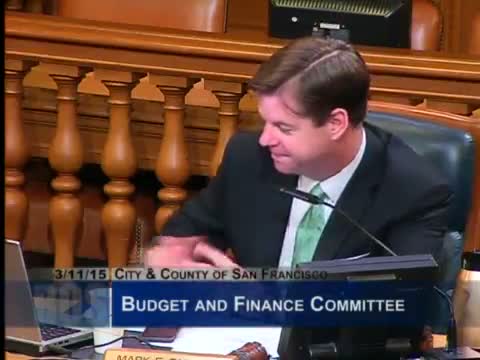
The San Francisco Board of Supervisors Budget and Finance Committee on its first 2015 meeting reviewed a proposed five-year financial plan showing strong near-term revenue growth but larger expenditure increases that create a structural budget gap.
Kate Howard, the mayor—s budget director, told the five-member committee that the plan projects roughly 13% revenue growth over five years while expenditures could grow about 23%, producing the multi-year shortfalls the city will need to address. "The gap between the 13% growth in revenues and the 23% growth in expenditures really is the problem statement," Howard said.
The plan is a joint projection prepared by the mayor—s budget office, the controller—s office and the board—s budget and legislative analyst—s office. Howard said it incorporates known changes including funding for the new San Francisco General Hospital, public-safety hiring plans, the voter-approved MTA baseline increase, the city—s minimum-wage increase and the renewal of the children—s fund.
For the first time the plan includes a recession scenario. Howard said modeling a downturn similar to past recessions would "lose almost a billion dollars in revenue" over three years compared with the base case and that volatile revenue sources such as transfer taxes could decline sharply. She warned that the same downturn would increase demand for social services while constraining revenue, intensifying pressure on reserves and spending choices.
Howard outlined fiscal strategies to narrow gaps without across-the-board cuts in the first year: slowing capital spending, restructuring debt to generate savings, managing wage and benefit costs, pursuing targeted new revenues and asking departments to propose about 1% in ongoing reductions or new revenue in the plan—s second year (an estimate the presentation put at roughly $18 million citywide). She also described relying more heavily on one-time spending reductions (capital, IT, equipment) in a severe downturn.
On the state budget, Howard said the governor—s proposal could yield a modest one-time benefit (about $6 million) while also producing offsets the city expects, including roughly $3 million in additional workers— compensation costs and about an $8 million decline in gas-tax receipts that support street repaving.
Supervisor Katie Tang praised the inclusion of a recession scenario, saying it is important to plan for downturns that can arrive without warning. Chair Mark Farrell and Howard confirmed the presentation used numbers compiled months earlier; Howard said she expected updated figures within about a week and that an action item on the updated five-year plan would return to committee in roughly three weeks. The mayor is scheduled to propose a balanced budget to the board on June 1.
The committee took the routine procedural step of filing the hearing record for Item 1 after Supervisor Tang moved to file it; the motion was accepted without objection. Item 2 (standing budget updates from the mayor, controller and budget analyst) was continued to the call of the chair after a motion recorded in the transcript as moved by "Supervisor Marr," which also passed without objection.
What happens next: staff will supply updated five-year figures to the committee in the coming weeks, the committee will hold budget hearings in April and May on focused subject-matter areas and the mayor will deliver a proposed budget on June 1.
Sources: presentation and Q&A with Kate Howard, mayor—s budget director, and committee proceedings.