Get Full Government Meeting Transcripts, Videos, & Alerts Forever!
Get email alerts on the Childcare Tax Credit topic
No spam. Unsubscribe anytime.
Committee advances ordinance to give developers tax credit for on‑site childcare; amendment clarifies hotel and parking exclusions
Summary
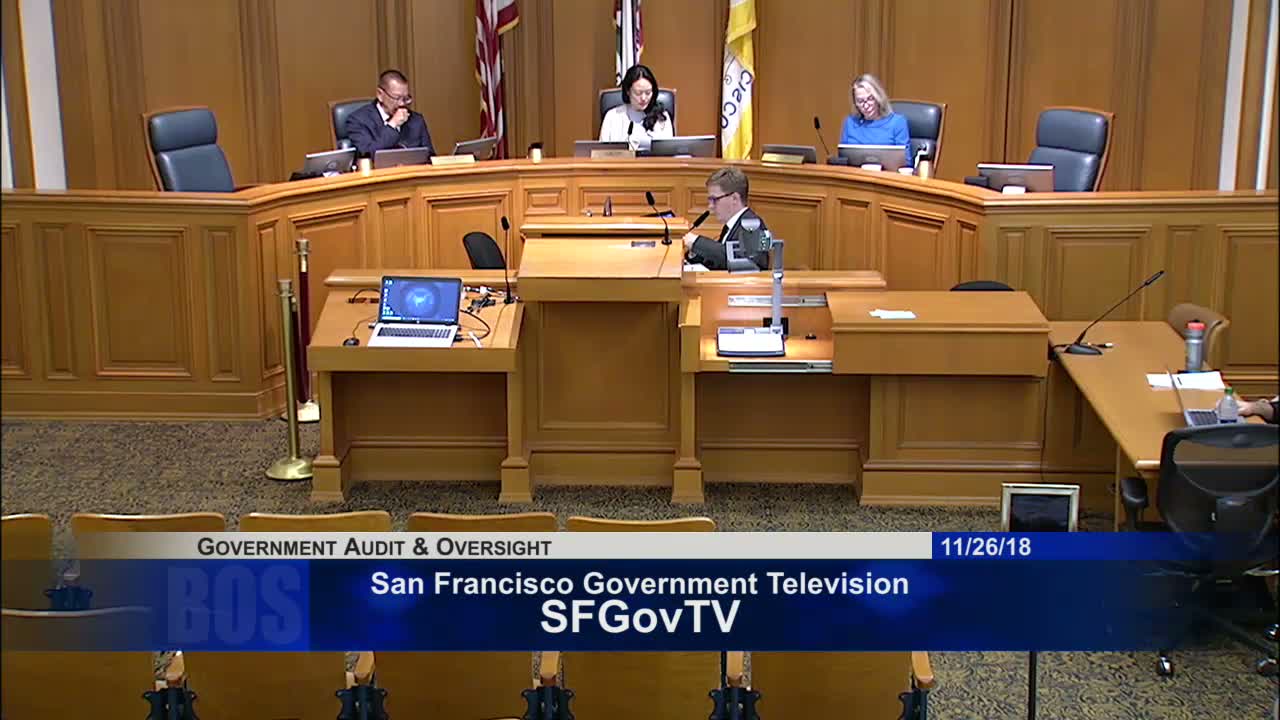
The Government Audit and Oversight Committee voted to advance an ordinance that would give property owners a tax credit for providing on‑site childcare under Proposition C; the panel adopted an amendment to exclude hotel and parking leases from the tax base and sent the ordinance to the Board of Supervisors for consideration on Dec. 4, 2018.
Supervisor Jane Kim, chair of the Government Audit and Oversight Committee, said the ordinance would implement parts of Proposition C by offering property owners a tax credit to encourage on‑site childcare facilities and expand space for working families.
“The childcare tax credit will offer developers and property owners a tax equal to 20% of the amount of rent paid on average by childcare facilities,” Kim said, describing the program’s dollar caps: “So a facility with 1 to 49 children will be offered a credit of 7,200. Facilities with 50 to 99 children will be offered a credit of 16,000. And a facility of 100 or more will be eligible for a $38,000 credit.”
The ordinance amends the city’s business and tax regulations code to provide the credit against the early care and education commercial rents tax and to exclude from that tax base amounts already subject to the hotel tax or parking tax. Chair Kim said she would offer an amendment to clarify ambiguity in Proposition C over whether hotel and parking leases would be treated as taxable commercial rent, and that the amendment would expressly not include rents subject to the taxes imposed under Article 7 or Article 9.
Sevin Campbell of the Budget and Legislative Analyst office provided the committee’s fiscal estimate, telling members, “There are 312 licensed childcare centers in San Francisco.” Based on the analyst’s review of the licensed‑center database and estimated tax revenues, Campbell said the ordinance’s upper bound for the tax credit would be “close to $4,000,000, based on estimated tax revenues of 146,000,000,” while cautioning the actual credit would likely be substantially less because many childcare facilities are not subject to the commercial rents tax.
Supervisor Norman Yi, the ordinance cosponsor, urged the committee to advance the measure so developers would know incentives were available as Proposition C revenues came online. “We’re gonna be able to serve another 5,000, if not more, children,” Yi said, describing why incentives to expand facility space are needed.
After the presentation and with no public comment, Chair Kim asked the committee to adopt the proposed clarifying amendment. Committee members advanced the measure by unanimous consent; Supervisor Yi moved to forward the item out of committee with a positive recommendation to the Board of Supervisors, and the motion was seconded and carried without objection. Clerk John Carroll noted that items acted upon would appear on the Board agenda on Dec. 4, 2018.
The ordinance as amended will proceed to the full Board of Supervisors, where members will have the opportunity to debate the measure further, consider any additional amendments, and vote on final adoption.