Get Full Government Meeting Transcripts, Videos, & Alerts Forever!
Get email alerts on the Economic Development topic
No spam. Unsubscribe anytime.
City Officials Outline 2014 Economic Strategy Update, Stress Housing, Workforce and Permitting
Summary
OEWD and the Comptroller's Office presented a 2014 update to San Francisco's economic strategy, emphasizing workforce academies, business-support programs, and the need to address housing-driven labor costs, permitting burdens and inclusion to sustain job growth across sectors.
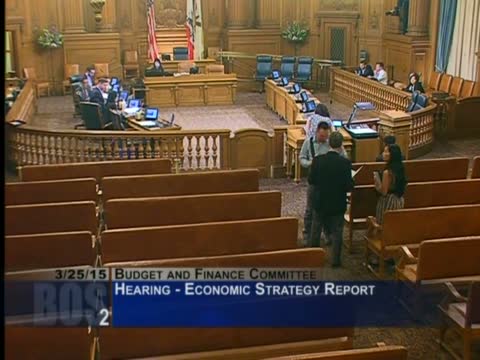
City economic officials presented the 2014 update to San Francisco's economic strategy at the March 25 Budget & Finance Committee meeting, reviewing progress since the 2007 plan and recommending next steps to sustain growth while addressing inequality.
Todd Rufo of the Office of Economic and Workforce Development introduced the update and said the strategy organizes the economy into "export" industries (technology, creative, financial services) and "local-serving" industries (health care, retail, construction). Laurel Levonatidis described action areas including workforce academies, small-business support, loan funds, a one-stop business assistance portal and neighborhood commercial corridor investments.
"For every 20% of broadband penetration, there is a correlated 1% growth in GDP," Levonatidis said, outlining investments in digital literacy, youth tech labs and fiber infrastructure. She highlighted programs that provide loans and technical assistance and the city's efforts to create space for new businesses and preserve PDR (production, distribution, repair) uses.
Ted Egan of the Comptroller's Office presented data showing rapid growth in creative and experience sectors and more mixed outcomes for local-serving industries between 2004 and 2010. Egan said labor costs, driven largely by housing prices, are the largest competitive disadvantage for local businesses in San Francisco compared with other Bay Area locations.
"Labor costs are the biggest source of cost difference between San Francisco and other places in the Bay Area," Egan said. Supervisors asked about inequality metrics since the 2007 plan and the role of City College and local-hire policies to ensure middle-wage job access. Officials said City College and CityBuild are key partners for training and local-hire provisions aim to direct construction jobs to San Franciscans.
Supervisors also raised permitting timelines and regulatory burdens as barriers to business expansion; officials said streamlining permitting and the business portal remain priorities. The committee continued Item 2 to the call of the chair for further follow-up and adjourned.