Get Full Government Meeting Transcripts, Videos, & Alerts Forever!
Get email alerts on the Behavioral Health topic
No spam. Unsubscribe anytime.
Budget office audit finds gaps in San Francisco behavioral‑health system; supervisors press for targeted follow‑up
Summary
A Budget & Legislative Analyst report identified underperforming civil‑service clinics, a shortage of intensive case‑management capacity and weak transitions from psychiatric emergency services; supervisors and the Department of Public Health agreed to a follow‑up focusing on roughly 2,200 high‑use individuals who drive a disproportionate share of emergency costs.
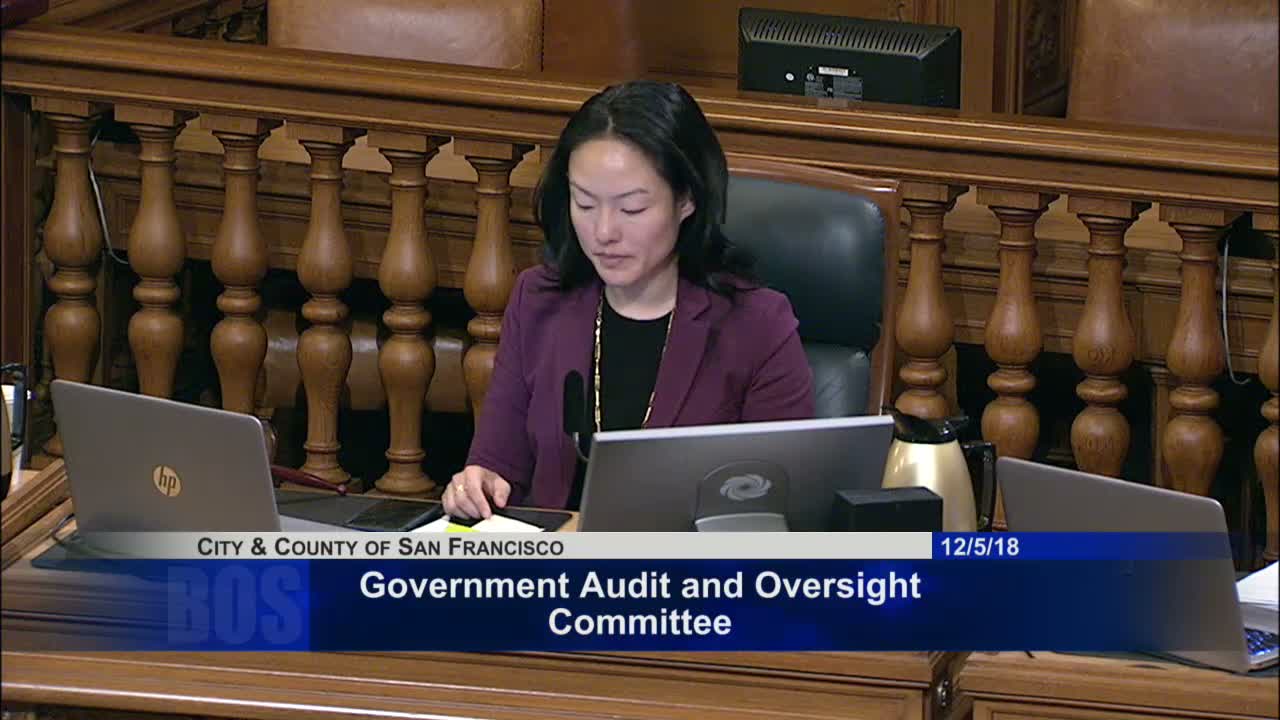
The city’s Budget and Legislative Analyst (BLA) told the Government Audit and Oversight Committee on Dec. 5 that San Francisco’s behavioral‑health system has several weaknesses that limit its ability to prevent repeated crisis care use.
Latoya McDonald, the BLA project manager, said the office reviewed five fiscal years of Behavioral Health Services (BHS) data and identified eight findings and 15 recommendations. “So when we talk about behavioral health, we’re referring to mental health and substance use disorder services,” McDonald said in her presentation, noting BHS served about 23,000 to 25,000 adults annually in the audit period and that system costs run in the hundreds of millions of dollars a year.
The audit’s main conclusions were that (1) city civil service clinics scored lower on the BLA’s performance metrics than community‑based organizations and lack formal corrective‑action procedures; (2) intensive case management (ICM) capacity has not kept pace with demand, leaving an unmet need; and (3) many people discharged from psychiatric emergency services (PES) do not link to outpatient care. The BLA also flagged a concentrated group of “high users” — roughly 5 percent of individuals using urgent and emergency services — that account for a far larger share of system costs.
McDonald said the BLA found that “for every adult discharged from intensive case management, more than two adults were referred to services,” and that 38 percent of PES discharges in FY 2016–17 did not have documented outpatient linkages. The BLA recommended clearer client‑readiness tools, better wait‑list monitoring, corrective plans for underperforming civil‑service clinics and improved PES discharge protocols and notifications to community providers.
Department of Public Health representatives told supervisors they welcomed the audit and described actions already under way. Cavus Ganem Basseri, the department’s Behavioral Health representative, said the department has implemented a Tableau business‑intelligence system for more timely monitoring, has created quality‑improvement plans for community providers and is expanding ICM slots and pilot programs. “We are reviewing that closely,” he said, describing plans to add transitional slots, assisted‑outpatient slots and approximately 200 additional ICM placements this year.
Supervisors pressed for more specific, short‑term plans for the population the BLA identified as driving a large share of cost. Supervisor Safai, who requested the audit, asked DPH to return with a focused follow‑up that pinpoints roughly 2,200 individuals the BLA highlighted and lays out a strategy — staffing, housing placements or other interventions — to reduce emergency‑care utilization and costs.
Clinicians and jail‑health leaders who testified at the hearing urged a system‑wide approach. Dr. Mark Leary, interim chief of psychiatry at Zuckerberg San Francisco General, said short inpatient stays to manage meth‑induced psychosis and better linkage to housing and treatment could reduce repeated emergency use. Lisa Pratt, director of jail health, said jails see many people with substance‑use issues and that jail‑based treatment (including medication‑assisted therapy) can be an access point but is not a substitute for stable community care.
Community providers and advocates who spoke during public comment emphasized the need for supportive housing, faster access to ICM, better coordination across city departments and careful use of new revenues (such as Proposition C). Several speakers urged that any expansion of involuntary tools such as conservatorship be paired with available treatment and housing.
The committee voted to continue the item to the call of the chair so DPH and partner agencies can return with the more focused plan requested by supervisors, including specific recommendations for the high‑using cohort and how to deploy funding and staff to reduce emergency‑care recidivism.