Get Full Government Meeting Transcripts, Videos, & Alerts Forever!
Get email alerts on the Healthcare Drug Pricing topic
No spam. Unsubscribe anytime.
Supervisors Hear That Specialty Tiers Are Pricing Patients Out of Life-Saving Drugs
Summary
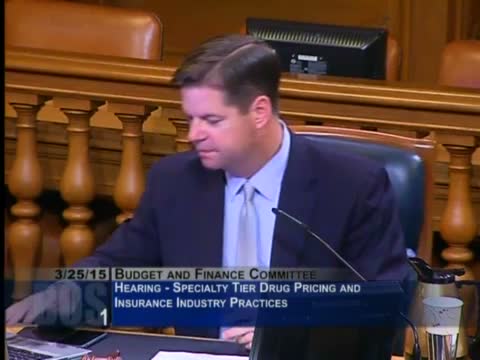
At a March 25 Budget & Finance Committee hearing, city health officials, advocates and insurers discussed insurers classifying HIV, hepatitis C and other medications as "specialty" and the resulting coinsurance that can reach hundreds of dollars a month, potentially blocking access and undermining San Francisco's HIV strategy. Speakers urged state and federal reforms and greater formulary transparency.
Supervisors gathered March 25 to examine a growing trend in which insurers place high-cost medicines into a "specialty" tier that shifts patients from fixed copays to coinsurance, sometimes hundreds of dollars a month, and can make essential treatments unaffordable.
"Reclassifying a drug as, quote unquote, specialty means that instead of a patient paying a typical monthly copay, they must pay a significant percentage of the drug's cost, which can often mean a monthly coinsurance payment of $600 or a thousand dollars or more," Supervisor Scott Wiener said, opening the committee's oversight hearing.
Colleen Chavla of the Department of Public Health told the committee there is no single technical definition of "specialty"; plans often use it for drugs that require special handling or administration but increasingly apply the label to medicines priced above an informal threshold (often around $600 a month). Chavla cited Covered California analyses showing that some plans put large shares of HIV and cancer drugs in the highest tier and noted a Centers for Medicare & Medicaid Services statement that placing most or all drugs for a condition on the highest tier may constitute discrimination.
"When those drugs are reclassified as so-called specialty drugs, they will become less healthy, they will get more sick, they could die, and they will be at increased risk of infecting other people," Wiener said, arguing that high cost-sharing undermines San Francisco's prevention and treatment strategies for HIV.
Representatives of Blue Shield of California, the only insurer to appear at the hearing, said the company tiers drugs primarily by cost and that most HIV drugs in its formularies are not on the highest tier. "Our mission is to ensure all Californians have access to high quality care at an affordable price," Tom Epstein, vice president of public affairs at Blue Shield, said, adding that Blue Shield's products comply with federal and state law and Covered California rules.
Advocates said cost-based tiering leaves patients with few options. Donnelly of Project Inform described statewide Covered California work-group reforms requiring improved formulary transparency and a standardized tier definition, and James Laduca of the San Francisco AIDS Foundation said his organization has documented employer and plan moves that put HIV medicines and hepatitis C treatments into high tiers. "High out of pocket costs for prescription drugs can lead to real access and adherence issues," Laduca said.
Matthew Sachs, a PrEP and benefits navigator at the foundation, described a pilot that enrolled 168 people: 60 percent were insured and 17 had specialty-tier problems that blocked access to pre-exposure prophylaxis. Michael Smith, a member of the public, gave a personal example of a drug that had been quoted at $50 a month and cost him $650.
Advocates and DPH staff pointed to two bills under consideration in the state legislature: AB 339 (to prevent insurers from placing all drugs for a condition on the highest-cost tier) and AB 463 (to require manufacturer reporting on costs and profits for drugs priced above $10,000). Aaron Khan, speaking for Assemblymember David Chiu, said AB 463 would require manufacturers to disclose research, production and profit data for high-cost treatments.
Katherine Dodd of the city's Health Service System said the city currently absorbs increased specialty pharmacy costs for municipal plans but warned long-term pressures (including the federal Cadillac excise tax) could force plan design changes.
There was no formal vote on policy at the hearing; Supervisor Wiener moved to continue the item to the call of the chair and the motion carried without objection. Speakers urged regulators and lawmakers at the state and federal level to enforce nondiscrimination provisions and increase transparency so patients and purchasers can understand how formularies affect access.
The committee will take up further steps as staff and advocates continue conversations with insurers and state regulators.