Get Full Government Meeting Transcripts, Videos, & Alerts Forever!
Get email alerts on the Mills Act topic
No spam. Unsubscribe anytime.
Committee backs two Mills Act contracts after debate on enforcement and term limits
Summary
The GAO Committee recommended moving two Mills Act historic-property contracts forward — for Woods Hall (215 & 229 Haight) and the Wilson Building (973 Market) — while supervisors pressed staff on enforcement histories, short-term rental fines and whether credits should reward rehabilitation done before approval; the committee directed staff and the Historic Preservation Commission to review policy tweaks and forwarded both items with a 10-year limitation.
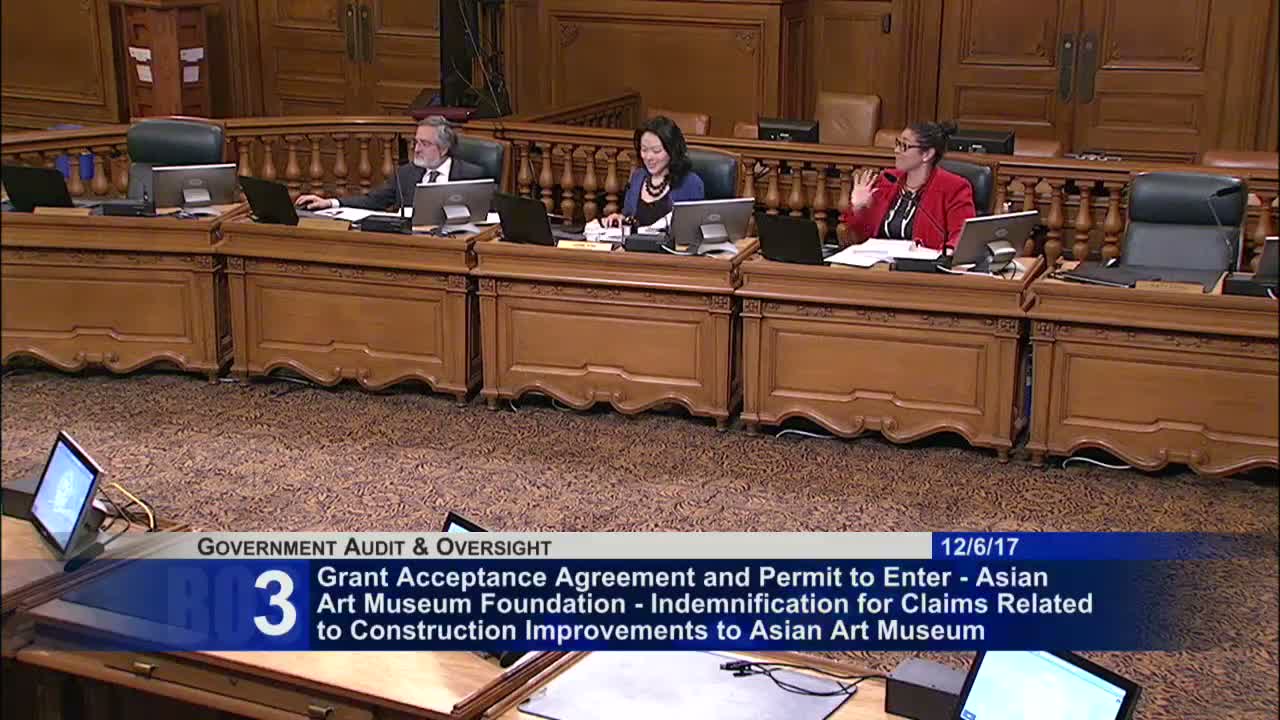
The Government Audit and Oversight Committee on Dec. 6 recommended approval of two Mills Act historic property contracts after a substantive policy exchange over enforcement history, program integrity and the proper length of tax‑credit agreements.
What the committee considered: Planning staff described the two applications: Woods Hall (215 & 229 Haight Street) and the Wilson Building (973 Market Street). The department's review noted applicable rehabilitation and maintenance plans, landmark designations (Woods Hall is San Francisco landmark numbers 257 and 258), and, in the case of 973 Market, prior short‑term rental enforcement. Staff reported the Office of Short Term Rentals had assessed a penalty of approximately $191,664 on Raintree (owner of 973 Market) for illegally offering short‑term units; Raintree paid the penalty and the enforcement case was closed.
Sponsor and owner statements: Bill Barnes (Supervisor Jeff Sheehy's office) described the Haight Street project's history and flagged enforcement follow-up. Jason Chek of Raintree Partners told the committee he had purchased the Wilson Building in 2011 when it was in serious disrepair, described extensive rehabilitation (seismic upgrades, terracotta repair, window replacement), and explained the short‑term rental fine stemmed from one corporate tenant ('Lumi') who leased multiple units and sublet in violation of the lease; Raintree paid the fine to resolve the matter and proceed with the Mills Act process.
Policy debate: Supervisors asked whether Mills Act benefits should be awarded when the bulk of rehabilitation work is already done, whether program rules unintentionally reward after‑the‑fact projects, and whether unresolved violations should bar Mills Act consideration. Supervisor Aaron Peskin said: "We don't want to see those come before the committee until they've been resolved," and urged clearer standards around eligibility. Staff (Tim Frey and planning staff) said the program allows "recently completed work" within a two‑year window but agreed to take the committee's concerns back to the Historic Preservation Commission and to consider a rehabilitation‑credit model and procedural improvements for the 2018 application cycle.
Outcome: Chair Kim proposed, and the committee approved, forwarding both Mills Act items with an instruction that the contracts be limited to a 10‑year term. The committee also asked staff and the historic preservation commission to review program procedures, enforcement preconditions, and whether the calculation of benefit and term lengths should be tailored for projects that have completed substantial work prior to application.
Why it matters: Mills Act contracts reduce property tax in exchange for long‑term preservation commitments; when applied to large rehabilitations and high‑value properties, they carry material fiscal implications for the city and raise questions about whether the incentive sustains work that would otherwise be done.
Next steps: Staff will notify the committee of the Historic Preservation Commission's follow‑up hearing and any proposed revisions to Mills Act application procedures.