Get Full Government Meeting Transcripts, Videos, & Alerts Forever!
Get email alerts on the Police Mou Negotiations topic
No spam. Unsubscribe anytime.
Supervisors hear hours of public testimony and staff briefings as MOU talks with police union continue
Summary
At a March 21 Government Audit & Oversight Committee hearing, supervisors, DHR and SFPD leaders discussed successor MOU talks with the San Francisco Police Officers Association amid intense public testimony demanding that contract negotiations not block DOJ-backed reforms. The committee filed the hearing for the record and forwarded related items to the full board.
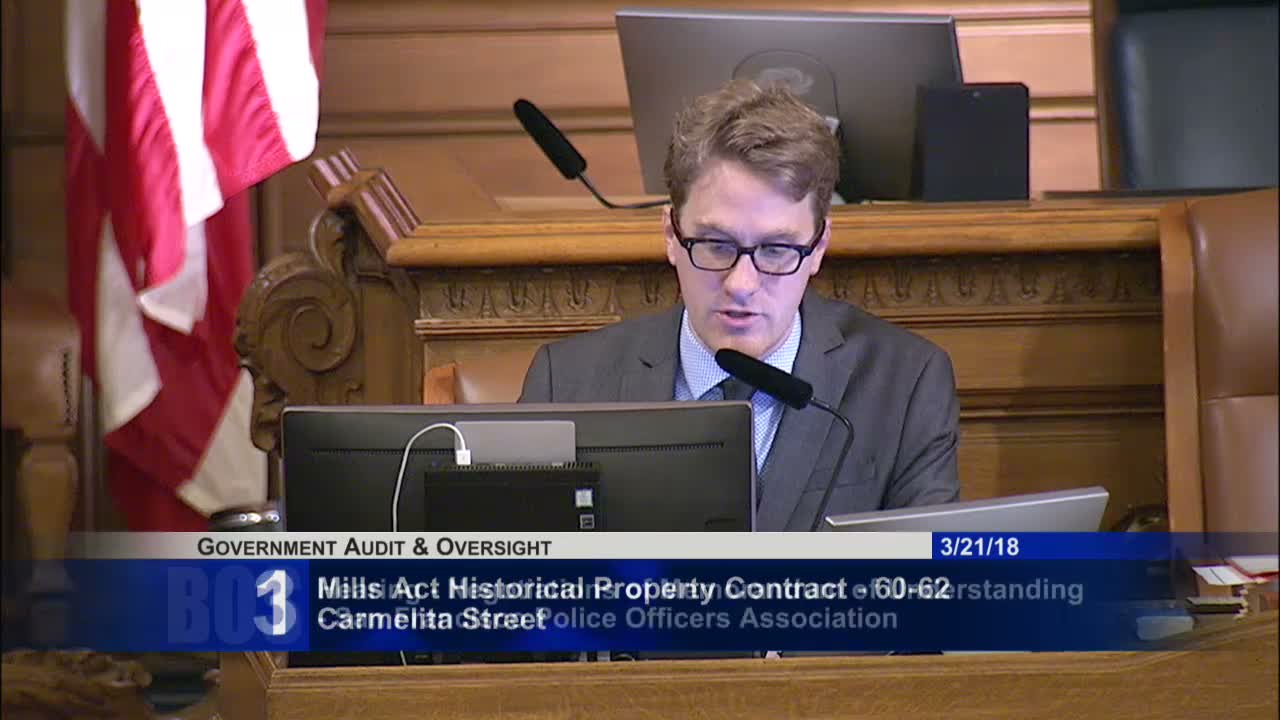
The San Francisco Board of Supervisors’ Government Audit and Oversight Committee on March 21 held a lengthy public hearing on successor memorandum-of-understanding negotiations between the city and the San Francisco Police Officers Association, focusing on whether contract language could be used to block police-reform measures.
Supervisor Malia Cohen, who sponsored the hearing, opened by saying the Board has a consultative role in bargaining and must ensure transparency in negotiations. ‘‘This is an important conversation that we’re having on behalf of the people, the city and county of San Francisco,’’ Cohen said, adding she would publicly identify changes she wants the mayor and the Department of Human Resources to press during bargaining.
Carol Eisen, employee relations director at the Department of Human Resources, described the charter and legal framework governing bargaining and interest arbitration (as stated to the committee), and said the city will meet the May 15 deadline to submit either a negotiated agreement or an arbitration award. Eisen told supervisors that some matters—disciplinary procedures and practices relating to complaint processing handled by the Department of Police Accountability, crowd-control policies and compliance with anti-discrimination laws—are exempt from interest-arbitration jurisdiction though they remain meet-and-confer subjects.
Deputy City Attorney John Givner briefed the committee on related litigation, saying the POA has appealed a challenge to the department’s use-of-force policy adopted in late 2016; the appeal is pending in the California Court of Appeal. Givner said the POA’s challenge centers on two aspects of the policy: prohibitions on shooting at moving vehicles and on carotid artery holds.
Budget and staffing also drew detailed questioning. Severn Campbell of the Budget Legislative Analyst’s office said the BLA is conducting a performance audit of police staffing and expects to file its report before the FY2019 budget process. She provided high-level budget figures to the committee: an overall SFPD budget of roughly $590,000,000; about $525,000,000 from the general fund; roughly $60,000,000 from airport funds for airport police; and total salaries and fringe just above $500,000,000, with uniform salaries and fringe around $415,000,000 and base uniform salaries near $300,000,000.
Police Chief William Scott described strategic priorities—crime prevention, data-driven deployment and community partnerships—and told supervisors the department had about 2,100 deployable officers as of January, with an authorized strength figure stated for the record.
Public comment dominated the hearing. More than two dozen speakers, including civil-rights attorneys, clergy, victims’ families and community organizers, urged supervisors to use MOU leverage to prevent the POA from invoking meet-and-confer or arbitration rights to block reforms recommended by the Department of Justice and other panels. Multiple speakers referenced the recent fatal shooting of Jesus Adolfo Delgado and said the family’s loss illustrated the urgency for accountability; several speakers described the shooting as involving ‘‘99 bullets’’ and called repeatedly for ‘‘No justice, no deal.’’
Speakers from community groups urged alternatives to policing—mental-health responders and community services—argued that the city’s bargaining stance should require the POA to commit not to obstruct reform, and urged the Board to press for specific reform language in the MOU.
Committee leaders thanked the public, said they would continue working on what can be negotiated and what should be implemented through policy, and moved to ‘‘file’’ the hearing for the record. The motion to file carried without opposition.
The committee made clear it will continue requesting follow-up material (including BLA audit results and more detailed budget and staffing breakdowns) and expects DHR and the mayor’s office to engage with the Board as negotiations proceed. The committee signaled it would press for clarity on which contract terms could be used to embed or block key reform measures before a final MOU is approved.
The committee’s next procedural step is to receive the BLA staffing audit and to continue oversight as the mayor and DHR move toward either a negotiated agreement or an arbitration award by the May 15 deadline.