Get Full Government Meeting Transcripts, Videos, & Alerts Forever!
Get email alerts on the Parks And Children Services topic
No spam. Unsubscribe anytime.
Supervisors press Rec & Park and youth agencies on staffing, vandalism and early‑childhood funding
Summary
Rec & Park reported rising demand, deferred maintenance exceeding $1 billion, and understaffed park patrols; DCYF and the Office of Early Care outlined plans tied to Proposition C and warned that state early‑education rates leave many providers underfunded. The committee tabled the hearing for follow-up.
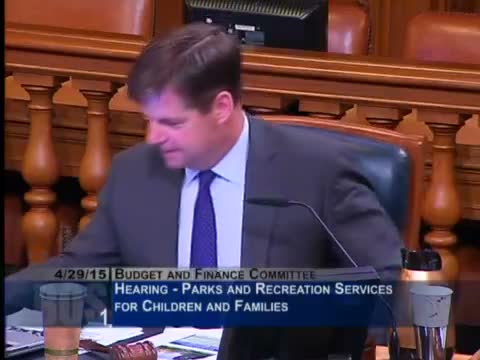
The Budget & Finance Committee on April 29 took a broad look at parks and services for children and families, hearing presentations from Recreation & Parks, the Department of Children, Youth and Their Families (DCYF), and the Office of Early Care and Education.
Rec & Park General Manager Phil Ginsburg framed parks as city infrastructure under growing strain from density and rising use. He reported an operating budget of about $143 million and a capital budget near $20 million, and said the department’s “total deferred maintenance budget is well over $1,000,000,000.” Ginsburg highlighted program demand—58,000 registrations across Rec & Park programs, nearly 13,000 summer‑camp registrations so far and expected 98% capacity by summer’s end—and said the department’s scholarship fund has grown from $80,000 to more than $1,100,000 annually.
On public‑safety staffing, Ginsburg said Rec & Park is budgeted for roughly 35 park‑ranger FTEs but has about 27–28 “boots on the ground” after attrition and training losses, which yields roughly three to four rangers on duty at any given time; he described an operational objective to move from a complaint‑driven model to assigning rangers to park service areas and said an ideal staffing level would be “north of 50.” Supervisors pressed on vandalism trends, graffiti and copper theft, and whether recent park‑hours and enforcement changes have reduced night‑time damage; Ginsburg said the department tracks vandalism incidents but that it is too soon to draw a definitive correlation to the hours changes.
The committee then heard from Maria Sue, director of the Department of Children, Youth and Their Families, who highlighted the November reauthorization of Proposition C (the Children and Families First Initiative) and said the measure will stabilize funding and extend services to transitional age youth up to age 24. DCYF reported serving about 56,000 children last year and said it will develop an equity matrix and a five‑year service allocation plan to guide new grant dollars and stabilize community‑based organizations.
Michelle Rutherford of the Office of Early Care and Education described the office’s current $49.8 million portfolio of subsidies, workforce supports and capacity initiatives. She emphasized a persistent gap between state reimbursement rates and local market costs: in some cases the state payment to providers is roughly half of local market rates, creating pressure on program sustainability. Rutherford said San Francisco is pursuing a regionalized rate and urged the board’s help in statewide advocacy; she also noted local proposals to use facility funds and local subsidies to protect and expand slots.
Child‑care and youth service providers in public comment urged the board to preserve operating support for Title 5 providers, to use Children & Youth Fund increases for service expansion (not to backfill minimum‑wage impacts), and to prioritize slots in high‑need neighborhoods.
Supervisor Tang moved to table the hearing for follow‑up work and planning in the budget process; the motion was seconded and adopted without objection. Committee members signaled continued engagement over the spring budget cycle on park patrol staffing, deferred maintenance funding and strategies to stabilize early‑care providers.