Get email alerts on the City Budget topic
No spam. Unsubscribe anytime.
Mayor presents balanced two‑year budget; controller flags revenue risks
Summary
Mayor—s proposed two‑year budget totals about $8.9 billion in year one and funds hospital opening, public safety hiring and major capital projects; Controller Ben Rosenfield called the revenue assumptions "reasonable" but warned of transfer tax volatility, gross receipts implementation risks and potential state clawbacks.
Kate Howard, the mayor—s budget director, briefed the Board—s Budget and Finance Committee on the mayor—s proposed two‑year budget, describing it as a balanced plan that funds San Francisco General Hospital operations, accelerates police and fire hiring and makes large investments in capital and information technology. Howard said the first year totals about $8.9 billion, with nearly $4.6 billion in the general fund and record levels of funding for capital and IT projects.
The presentation emphasized targeted social investments: 500 supportive housing units, continuation of the Navigation Center, expanded preschool slots and funding to backfill federal cuts for HIV services. Howard noted the budget fully funds new baselines created by Proposition C and includes a proposed $300 million housing bond and $79 million from the housing trust fund for production and stabilization work.
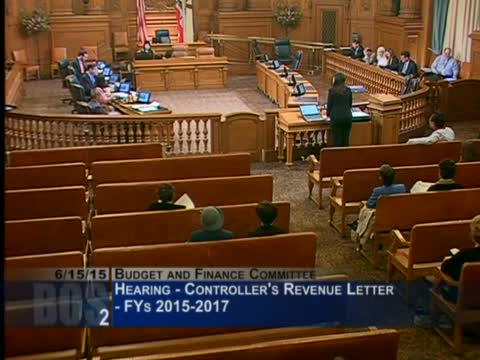
City Controller Ben Rosenfield delivered the office—s revenue letter, saying the mayor—s revenue assumptions are reasonable but identifying key risks. Rosenfield urged close monitoring of commercial real estate taxes and transfer taxes — the most volatile local source — and cautioned that the phase‑in of the new gross receipts business tax and potential state "realignment clawbacks" linked to the Affordable Care Act could alter revenue flows.
Rosenfield summarized planned reserve deposits and noted growing general‑fund reserves that provide a cushion for the two‑year period. He said the Controller—s Office will monitor incoming gross receipts remittances and report back to the mayor and Board as new data arrive.
The committee did not take final action on the overall budget at the hearing; members said they expect further hearings, public comment and votes in the coming week.
AI generated
The text on this page is AI generated. Summaries, highlights, analysis, and video transcripts are all produced from the original source material.
AI can make mistakes, so if you spot one, and we will fix it for everyone.
Note: the source content is unaltered by us. Any content source we link to, be it a video, an audio recording, or a document, is presented exactly as its publisher released it. That publisher is usually a government body, sometimes an individual official or another organisation.