Get Full Government Meeting Transcripts, Videos, & Alerts Forever!
Get email alerts on the Tall Building Safety topic
No spam. Unsubscribe anytime.
City unveils tall-building seismic-safety strategy with 16 recommendations after Millennium Tower scrutiny
Summary
A multi-agency tall-building safety strategy — the first of its kind nationally — maps 156 buildings over 240 feet, proposes short-, mid- and long-term actions (foundations guidance, welded-moment-frame inspection, BORP expansion and downtown recovery planning) and recommends administrative bulletins and code changes to improve post-quake inspections and resilience.
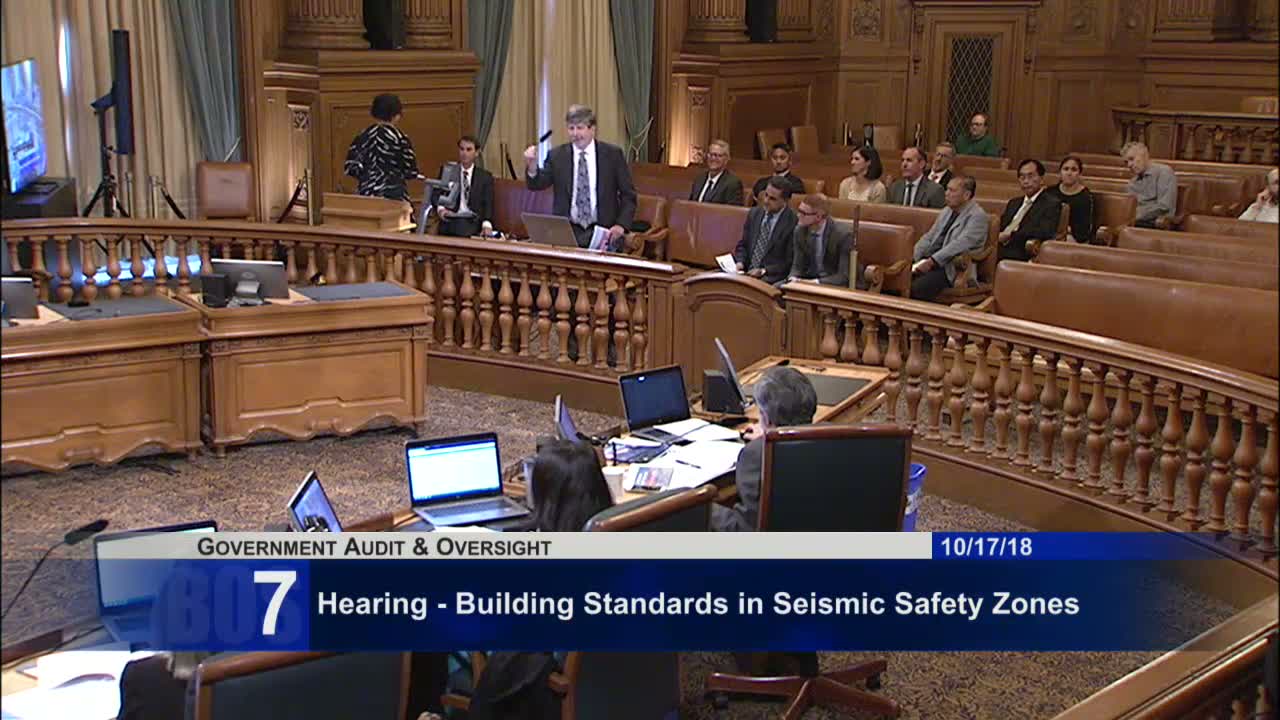
Supervisor Peskin introduced a broad, multi-department tall-building safety strategy — developed with an Applied Technology Council (ATC) team and the Office of Resilience — after concerns raised by the Millennium Tower settlement. The team released 16 recommendations grouped into short-, mid- and long-term actions and published a tall-building inventory (buildings above 240 feet; 156 entries) on the city data portal.
Key near-term recommendations include issuing administrative bulletins and enforcing post-earthquake inspection procedures (FEMA/ATC guidance) to look systematically for damage that may not be immediately evident in welded steel moment frames (less-visible fractures discovered after Northridge). The ATC team also recommended specialized postquake inspection teams for tall buildings and extensions to the Building Occupancy Resumption Program (BORP) to pre-certify engineers and accelerate green/yellow/red tagging and functional recovery.
A geotechnical lead proposed an administrative-bulletin companion to AB 83 focused on foundation-design guidance for tall buildings: acceptable total and differential settlement limits, required field investigations, laboratory testing, numerical-modeling practices, design of shoring/dewatering, and sea-level-rise considerations. ATC estimated localized peer review and adoption could take roughly 6–12 months for an AB-level guidance document.
DBI and the City Administrator said some recommendations can be implemented administratively immediately (peer-review use in permit evaluations and BORP expansion), while others will require code amendments in the 2019 triennial building-code update. Supervisors asked DBI to prepare legislative packages for items requiring board action and to work with stakeholders on implementation and cost-recovery where appropriate. The committee continued the matter to the call of the chair to advance implementation steps.