Get Full Government Meeting Transcripts, Videos, & Alerts Forever!
Get email alerts on the Community Benefit Districts topic
No spam. Unsubscribe anytime.
Committee reviews Community Benefit District annual reports; highlights cleaning, syringe pickup and camera programs
Summary
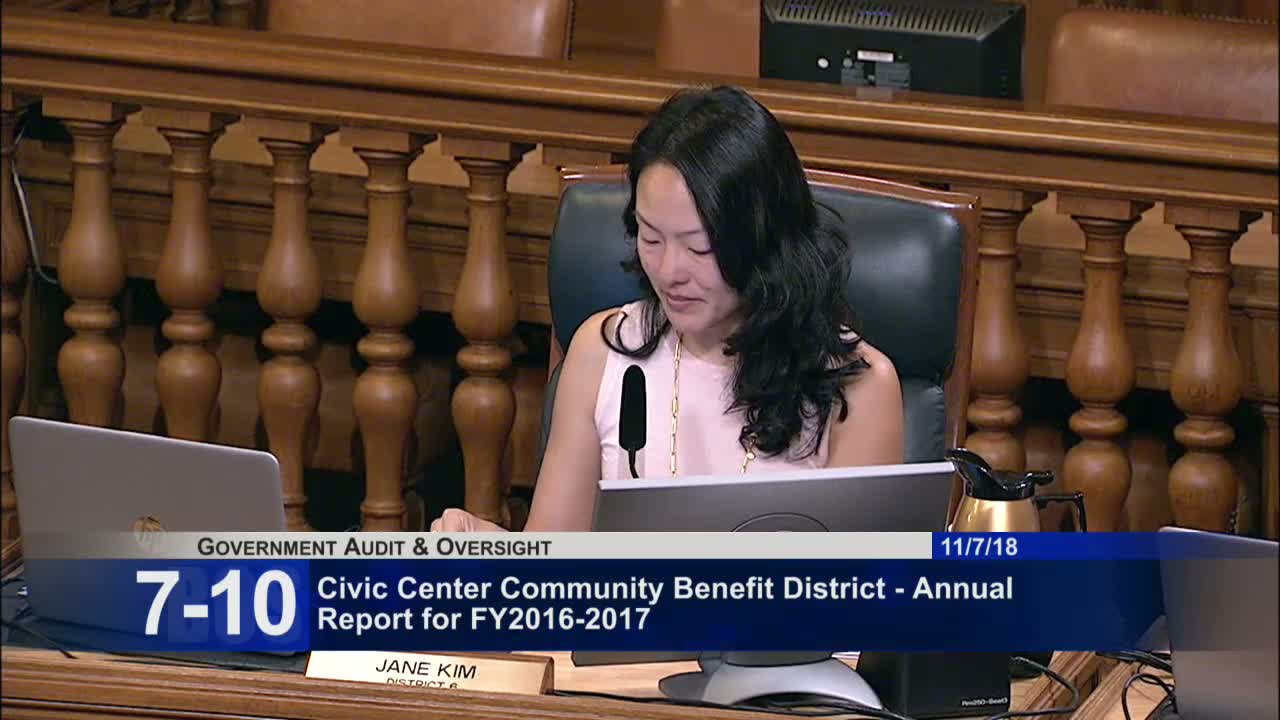
OEWD and four CBD executive directors presented FY2016–17 annual reports for Civic Center, Central Market, North of Market/Tenderloin and Lower Polk, noting cleaning and safety activities, changing syringe-collection counts, and expansion of security-camera and ambassador programs; the committee forwarded items with recommendation.
The Government Audit and Oversight Committee on Jan. 7 received presentations on annual reports from four Community Benefit Districts (CBDs) and advanced the associated resolutions to the full Board of Supervisors.
Chris Korgas and Helen Marr of the Office of Economic and Workforce Development (OEWD) presented staff reviews that found the Civic Center, Central Market, North of Market/Tenderloin and Lower Polk CBDs met OEWD benchmarks for budgeting, revenue sources and reporting. "Civic Center CBD has performed well in implementing the service plan for the district," OEWD staff said.
Tracy Everwein, executive director for Civic Center and Central Market CBDs, told the committee Civic Center's needle-collection numbers fell from about 1,000 syringes per month to roughly 500 per month after additional disposal and retrieval efforts by city agencies and nonprofits. "We actually think it's just a couple of things...the public library has put out big collection bins," Everwein said, crediting expanded services from the Department of Public Health, Downtown Streets Team and other partners.
Everwein also described Central Market trends: about 462 syringes per month in 2016, a spike in 2017 (reported as ~28,000 needles for the year) and about 3,000 syringes per month in 2018. She highlighted expansion of ambassador programs, co-responder safety teams and a security-camera program that has aided law enforcement. "We've added at least six more camera views with those resources," Everwein said, and cited an instance where nighttime video helped identify a suspect.
Simon Bertrand, executive director of the North of Market/Tenderloin CBD, described capacity building in FY2016—17: $561,000 raised from non-assessment sources (over 40% of the budget), expanded cleaning to seven days a week, installation of seven camera locations, removal of thousands of graffiti tags and hundreds of thousands of pounds of litter, and integration of Safe Passage into CBD operations.
Christian Martin presented Lower Polk's first-year highlights: rebranding and events to boost foot traffic, construction mitigation outreach, planter installations and mobile restroom (pit-stop) services. He reported thousands of graffiti removals, hundreds of thousands of pounds of trash collected, and partnerships with many city agencies and nonprofits.
Supervisor Veil Brown raised concerns that CBD cleaning and outreach can displace people into adjacent neighborhoods such as Hayes Valley; OEWD and CBD staff said they would coordinate with adjacent neighborhood groups. With no public comment, the committee forwarded items 7 through 10 and item 11 (a management agreement for the Discover Polk CBD) to the full Board with recommendation.
The Board of Supervisors will consider the CBD annual-report resolutions and the Discover Polk management agreement at future meetings.