Get Full Government Meeting Transcripts, Videos, & Alerts Forever!
Get email alerts on the Central Soma Cfd topic
No spam. Unsubscribe anytime.
Planning staff seek ROIs to form Central SoMa special tax district and to authorize up to $5.3 billion in bonding
Summary
Planning Department staff presented two Resolutions of Intent to establish a Central SoMa Special Tax District (a CFD) and to authorize bonded indebtedness not to exceed $5.3 billion; staff estimated about $2.2 billion in public benefits over 25 years, financing mechanics, exemptions for affordable housing, and proposed fee tiers and escalation rules.
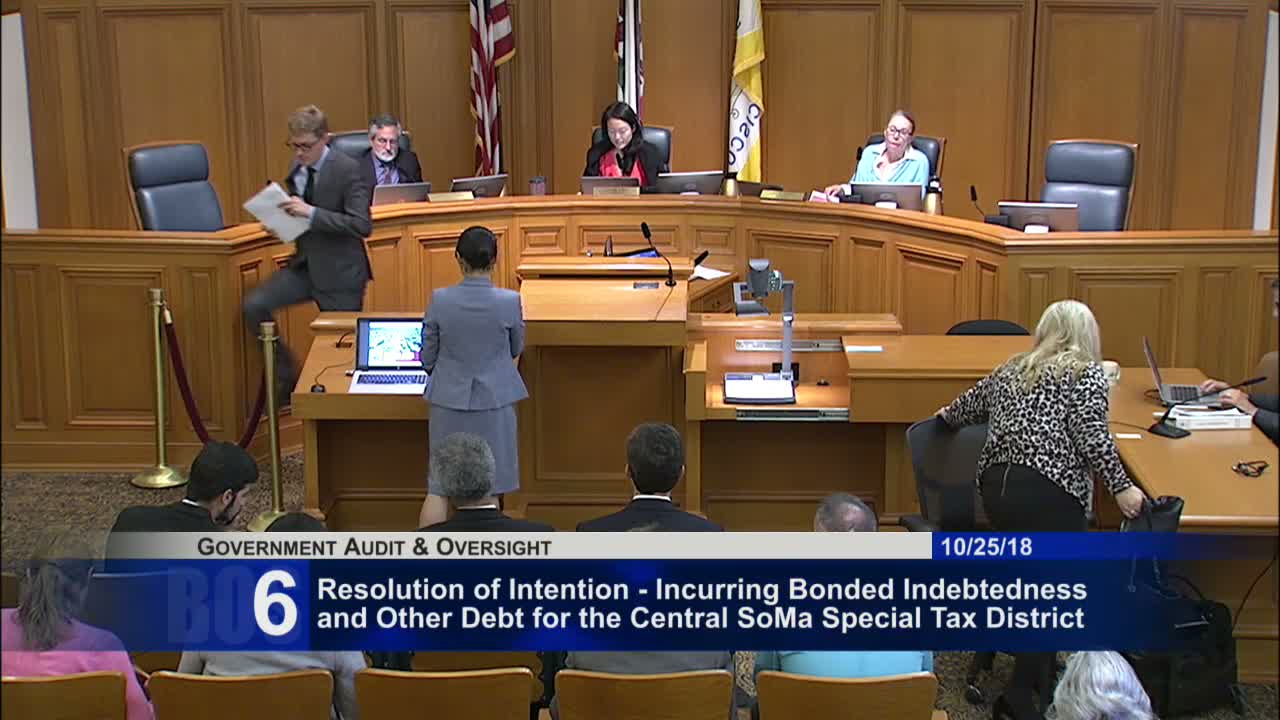
Planning Department senior planner Lisa Chen briefed the Government Audit & Oversight Committee on Oct. 25 about the Central SoMa plan and two Resolutions of Intent (ROIs) that would begin the formal process to create a Central SoMa Community Facilities District (CFD).
Chen said the whole plan anticipates roughly 32,500 jobs and 8,600 new housing units at build‑out—about 16 million square feet of development—and estimated nearly $2.2 billion in public benefits over roughly 25 years. She explained that the CFD, structured as an "all annexation" district, would require new development to annex into the district before occupancy, and that the tax would primarily apply to large condos and nonresidential projects while exempting 100% affordable housing, BMR units, rental housing, PDR and community facilities.
On finance mechanics, staff described two related figures: a CFD revenue projection of approximately $350 million (annual at peak) versus a not‑to‑exceed bond authorization of $5.3 billion in the ROI. Chen explained that the $5.3 billion is a conservative ceiling that assumes different bonding phasing, 99 years of capital term, and inflation adjustments; it is not an immediate issuance amount.
Staff described fee tiers, escalation rules (base rate escalation at 2% annually; nonresidential projects may escalate at 4% for 25 years then revert), and amendments introduced at a prior Land Use and Transportation Committee hearing that would modify applicability and rates for certain Tier B projects and lower the size threshold for taxable projects from 40,000 to 25,000 gross square feet, which staff said would be revenue neutral under current assumptions.
Chen said CEQA, implementing code amendments, an RMA (rate and method of apportionment), and a future annexation/formation hearing would follow ROIs and noted that the ROIs before the committee were the first official city actions to establish the CFD.
Public comment included concerns about the long time horizon and skepticism that benefits would reach existing residents; committee members asked that substantive amendments be continued for further review and set the items for further committee consideration on Nov. 7.