Get Full Government Meeting Transcripts, Videos, & Alerts Forever!
Get email alerts on the Housing Bmr Resale topic
No spam. Unsubscribe anytime.
Supervisors advance narrow fix to BMR resale rules to ease sales for a small number of homeowners
Summary
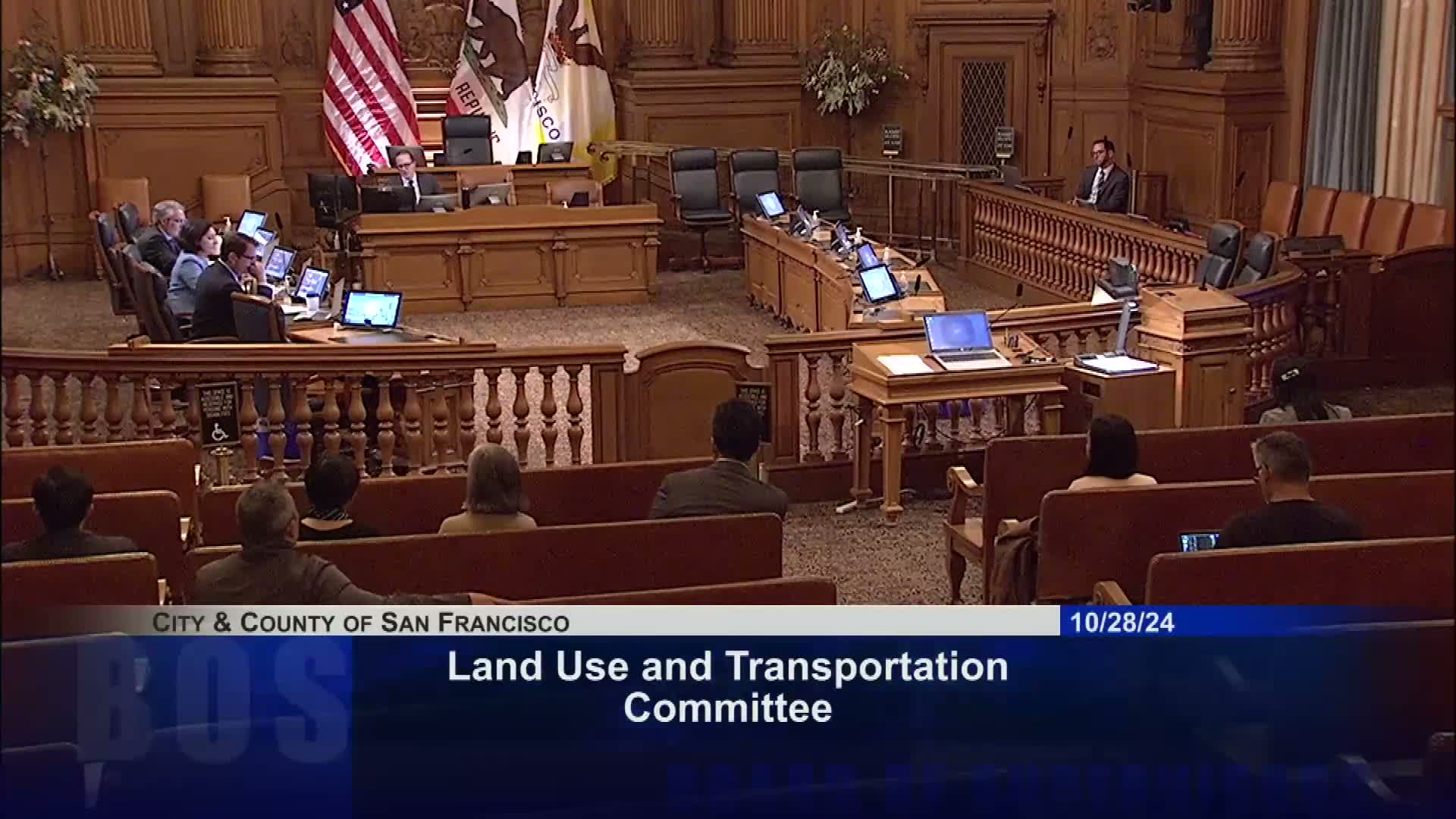
The committee approved amendments to allow limited increases in buyer AMI eligibility for some below-market-rate (BMR) owner-occupied resales, added reporting triggers after 10 adjustments and a requirement for annual MOHCD reporting and a public hearing; the ordinance was forwarded to the full Board as a committee report.
San Francisco supervisors on Oct. 28 advanced a narrowly tailored change to the city’s inclusionary homeownership rules that would let the Mayor’s Office of Housing and Community Development (MOHCD) raise the qualifying Area Median Income (AMI) for new buyers of certain below-market-rate (BMR) owner-occupied units when a unit’s maximum resale cap is higher than what a prospective buyer can afford.
The amendment, authored by Supervisor Melgar and recommended by the Land Use and Transportation Committee, is designed to address a limited set of cases in which the maximum allowable resale price and the affordability calculation for the next buyer have diverged. Melgar told the committee the problem surfaced in a Mission Local article describing a family who faced a loss of about $100,000 in equity after a resale pricing mismatch.
The committee adopted Melgar’s amendments requiring MOHCD to report to the Inclusionary Housing Technical Advisory Committee, the Planning Commission and the Board of Supervisors after 10 approved AMI adjustments, and annually thereafter. Each report must identify the location of adjusted units, the date of each adjustment and pricing and AMI information before and after the adjustment. The ordinance affirms the Planning Department’s CEQA determination and Planning Code consistency findings.
MOHCD director of homeownership programs Sissy Ng told the committee MOHCD currently identifies one unit that qualifies for the relief; she explained that the affordable resale price is calculated at the time a homeowner initiates a sale using current taxes, HOA dues, mortgage interest and other costs, so future affordable prices for hypothetical sales cannot be precomputed.
Committee members debated the potential scope of the change. Board President Aaron Peskin voiced concern that the problem could affect many more units than the sponsor expects and proposed a possible time-limited trial or sunset. Melgar and MOHCD emphasized they expect the effect to be small; Melgar also built in a 10-request trigger to require additional review by the Planning Commission to limit any unintended expansion of the policy.
After public comment in support (including from the Council of Community Housing Organizations), Chair Melgar moved to amend the ordinance as read, forward the amended original file to the full Board as a committee report for the Board’s Oct. 29 hearing, and duplicate a second file to be continued to Nov. 18 to allow any further technical amendment. Vice Chair Dean Preston and President Peskin joined Melgar in voting "aye," and the committee reported the amended ordinance to the Board.
The committee’s action forwards the ordinance to the full Board of Supervisors for consideration at its scheduled hearing. The duplicated file was continued to Nov. 18 to allow staff to finalize any technical changes requested by the committee.