Get Full Government Meeting Transcripts, Videos, & Alerts Forever!
Get email alerts on the Budget Reserve Policy topic
No spam. Unsubscribe anytime.
Controller proposes flexible reserve policy to grow contingency cap to 3% and permit recessionary drawdowns
Summary
Controller Ben Rosenfield proposed phasing the city's general reserve up to 3% of revenues if recovery continues, allow temporary reduction to 1.5% during recession, create an overflow account for stabilization reserves above 10% and clarify permissible uses if the board suspends reserves; the committee accepted technical amendments.
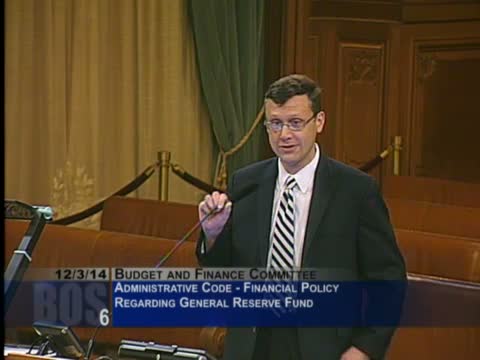
Controller Ben Rosenfield presented proposed changes to San Francisco’s financial‑policy framework at the Dec. 3 Budget & Finance Committee meeting, saying the existing contingency (general) reserve rules may be too inflexible in an economic downturn.
Rosenfield summarized the city’s two reserve types: a general contingency reserve for year‑to‑year unanticipated losses and stabilization reserves (rainy day and budget stabilization reserves) meant to smooth revenue cycles. He said the current policy phases the general reserve to 2% of revenues by fiscal year 2016–17 and that stabilization reserves together equaled roughly $192 million or about 4.8% of revenues — about half the 10% target.
The controller proposed phasing the general reserve to 3% over time if recovery continued and allowing the reserve to be reduced to 1.5% during declared recession years while the city is eligible to withdraw from the rainy‑day reserve, with a phased restoration schedule back to 3% once recovery resumes. He described an ‘‘overflow’’ account for stabilization‑reserve amounts above the 10% target that could be used for one‑time expenditures such as infrastructure, affordable housing or debt retirement, and clarified permissible uses of a suspended budget stabilization reserve if the board suspends it by a two‑thirds vote.
Rosenfield said the revised construct would increase the city’s ability to offset potential revenue losses in a future recession; he estimated the permissible reduction during downturns could free about $58 million in near‑term budget savings compared with a strict 2% rule.
Committee members and the budget analyst recommended modest timing changes to the phase‑in schedule and corrections to certain table entries; the controller agreed to submit revised legislation and the committee adopted the recommended technical amendments by unanimous consent.
Quote: "We're really trying to plan for further growth of the general reserve during periods of extended economic recovery, while at the same time creating greater flexibility in the reserve for times of recession or downturn," Rosenfield said.
Next step: The controller will submit revised ordinance language to the clerk incorporating the technical amendments discussed; the committee approved the amended item.