Get Full Government Meeting Transcripts, Videos, & Alerts Forever!
Get email alerts on the Das Streetlight Poles topic
No spam. Unsubscribe anytime.
Committee forwards SFPUC master license agreements to the board for streetlight pole DAS installations
Summary
The committee voted to recommend master license agreements enabling carriers (Extenet and Verizon) to install distributed antenna systems on selected SFPUC streetlight poles after assurances on aesthetics, DPW/Article 25 community review, city fiber strands, and projected revenues.
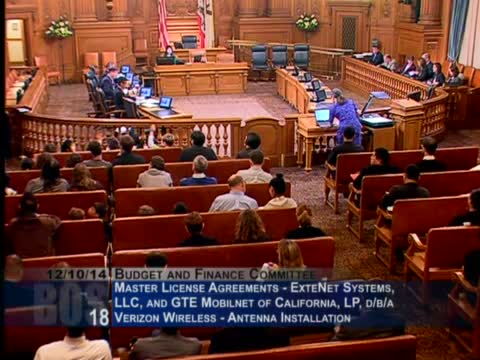
The Budget & Finance Committee on Dec. 10 recommended that the full Board of Supervisors approve master license agreements (MLAs) allowing wireless carriers to install distributed antenna systems (DAS) on San Francisco Public Utilities Commission streetlight poles.
Barbara Hale, assistant general manager for power at the SFPUC, briefed the committee on the proposed program. "The master license agreements that are before you have a term of 12 years, and we anticipate that they will generate revenue in excess of a million dollars," Hale said, adding that licensees would provide four strands of fiber to each pole for city use and that the program would avoid historic decorative poles.
She described the DAS as low-power antennas connected to carrier hubs by fiber optics to increase wireless capacity in heavy-traffic areas where traditional macro towers are impractical. Hale said installations would be reviewed through DPW and planning, including Article 25 community notice and CEQA review as applicable, and the PUC retains authority to remove devices if city utility needs require it.
Budget analyst Harvey Rose summarized revenue estimates, stating the low and high 12-year projections range from about $10.1 million for 200 poles to $14.5 million for 270 poles, based on an initial $4,000 annual license fee per pole and one-time application fees. Private-sector witnesses from Verizon and Extenet described similar deployments elsewhere and stressed capacity and emergency-services benefits; Verizon noted an appeals pathway to the board of appeals.
Supervisors pressed for strong design standards to limit visual intrusiveness and asked how many carriers might use the program; planning and PUC staff said several carriers were interested and stressed coordination to avoid clutter on decorative streets. After discussion, the committee moved item 18 forward without objection and recommended approval to the full board.
Next steps: the Board of Supervisors will consider the MLAs; PUC and DPW will continue coordinating equipment review, community notice per Article 25, and CEQA compliance where required.