Get Full Government Meeting Transcripts, Videos, & Alerts Forever!
Get email alerts on the Streets And Infrastructure topic
No spam. Unsubscribe anytime.
Supervisors Press Agencies on Road Repairs and Coordination as City Invests in Resurfacing
Summary
Supervisors pressed Public Works, the SFMTA and the PUC to improve coordination of paving, utility repairs and outreach after a national report ranked San Francisco among regions with the worst urban road conditions; agencies said $90 million in state funding and new coordination tools are in place but neighborhood frustration persists.
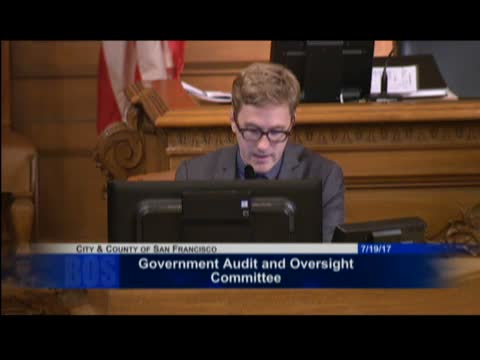
Chair Jane Kim opened a July 19 Government Audit & Oversight Committee hearing on San Francisco’s road conditions, saying the city must balance a major resurfacing investment with minimizing disruption to residents and businesses. The committee invited Public Works, the San Francisco Municipal Transportation Agency and the Public Utilities Commission to explain coordination, repair techniques and outreach.
The hearing followed a November 2016 TRIP (a national transportation research group) report that, in the city’s peer group, rated San Francisco among the poorest for major‑road condition. “Given this huge investment in our streets, we need to get things right,” Supervisor Aaron Peskin said, noting a two‑year, nearly $90 million commitment in the state budget to pay for pothole repair, striping and safety measures and a city goal to raise the pavement condition index (PCI) to 70 by 2025.
John Thomas, City Engineer for Public Works, told the committee the department now uses an Envista planning system to coordinate capital projects across agencies and utilities. Thomas said since February 2008 the city has paved roughly 5,000 blocks (about 40 percent of blocks citywide), with approximately 4,300 of those since 2011, and that the department’s target is about 600 blocks per year. He described routine coordination meetings with the MTA and PUC and a five‑year moratorium that protects newly reconstructed streets from excavation for five years, subject to exceptions for emergencies or new service connections.
Supervisors raised multiple concerns about implementation and neighborhood impacts. Supervisor Sandra Feuer cited repeated excavation on 20 Fifth Avenue caused by unexpected sewer lateral failures and said residents are frustrated when streets are dug up repeatedly. “I actually think that it is this is a prime example of what should be put at the top of the list,” Feuer said about examples of deteriorating neighborhood streets; Thomas said that severe lateral failures sometimes require additional excavation and explained the department’s decision to apply temporary paving in some corridors while utilities coordinate follow‑on work.
Committee members pressed the agencies on prioritization: Peskin asked how streets are ranked and why some projects (for example, crossover Drive) can be advanced rapidly. Thomas said prioritization relies on PCI scores, traffic volumes, bus routes and other factors and that the Envista plan is publicly posted. He acknowledged occasional reprioritization when a safety or high‑use site needs urgent attention.
The hearing also explored pavement preservation techniques and pothole response. Thomas said Public Works resurfaces about 200 blocks annually with microsurfacing, a less expensive preservation method effective on blocks with PCI in the ~70–75 range, and that the department continually evaluates newer technologies. Supervisors reported constituents’ experiences suggesting 311 pothole reports are sometimes closed without repair; Peskin said his intern review found only about one‑third of 30 tested reports were timely resolved. Thomas said operational dashboard (stat) meetings show roughly 90 percent of pothole requests are addressed within 48 hours and promised to reconcile the data with the committee.
SFMTA’s Luis Montoya and Sean Kennedy described how Muni Forward and Vision Zero safety projects are coordinated with paving and utility work to maximize safety and minimize rework. Montoya said site selection for projects considers the capital improvement program, collision history and connectivity goals; he acknowledged community frustration when outreach does not reach elderly residents or others who do not attend public meetings.
PUC spokesman Dave Briggs said his agency has tripled renewal and replacement activity for water and sewer mains in recent years and that much of the increased work is proactive — replacing pipelines before they fail. Briggs described outreach practices and said the PUC is trying to improve notification and on‑site presence during noisy or nighttime work.
Throughout the hearing, supervisors emphasized better notice and tangible outreach to residents and small businesses, and asked whether undergrounding utilities should be considered when streets are already excavated; agencies said undergrounding is expensive (an example figure discussed was about $500,000 per block depending on circumstances), has technical constraints, and would require funding and property owner participation.
The committee closed public comment and agreed to file the item for follow‑up and further coordination with Public Works, MTA and PUC. “We will continue to follow up offline,” Supervisor Peskin said. The committee voted to file the hearing without opposition, reserving technical follow‑up on the discrepancies in pothole response data and requests for a report on interim measures for streets like Geary/Gary Boulevard.