Get Full Government Meeting Transcripts, Videos, & Alerts Forever!
Get email alerts on the Working Conditions Security Guards topic
No spam. Unsubscribe anytime.
Supervisors, museum officials and guards spar over 35‑ vs. 40‑hour schedules at Fine Arts Museums hearing
Summary
At a June 20, 2017 Government Audit & Oversight Committee hearing, museum officials defended a 35‑hour staffing model as fiscally and operationally necessary while guards, union representatives and Supervisors pushed to restore 40‑hour schedules citing pay, benefits and briefing/debriefing time. The item was continued to the call of the chair for further work with DHR and labor.
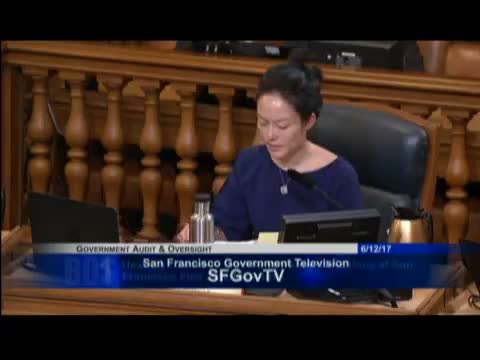
The San Francisco Board of Supervisors’ Government Audit & Oversight Committee held a special hearing June 20, 2017 on working conditions for security guards at the Fine Arts Museums of San Francisco and the Asian Art Museum, where city Human Resources officials and museum managers defended a long‑standing 35‑hour model while guards and union representatives urged restoring 40‑hour positions to improve pay, benefits and on‑the‑job briefing.
Supervisor Aaron Peskin, who called the hearing, framed the issue as both operational and moral, saying the city should “give real jobs that are full time jobs, where people can support their families, and that those extra hours can be pensionable.” Peskin pressed museum and DHR officials on whether existing overtime and event hours could be reallocated to raise part‑time guards to full‑time status.
Luana Preston, employee relations manager at the Department of Human Resources (DHR), reviewed the bargaining history that led to the current schedules. She told the committee that concessions during the city’s 2008 budget crisis reduced many museum guards from 40 to 35 hours; a 2011 settlement allowed previously‑40‑hour guards an opportunity to return to 40 hours but most subsequent hires were made at 35 hours. Preston said the city has agreed to mediation with SEIU and asked the union to pursue that process before taking other actions, noting, “DHR is here this morning to support the department's position on this issue because it's fiscally sound and it meets the operational needs of both departments.”
Museum officials said the 35‑hour schedule is tied to operating hours and budgeting constraints. Charlie Castillo, director of human resources administration for the Fine Arts Museums, described the institutions as a public‑private partnership and said the museums’ funding mix is roughly 22% public and 78% private. He said the hour‑matching model adopted in 2008 avoided layoffs and aligned paid hours with periods when visitors are present. Castillo reported that the Fine Arts Museums recorded 21,504 overtime hours in fiscal 2015–16, costing $899,566, most of which is covered by the museums’ private side.
Mara Finnerty, chief human resources officer at the Asian Art Museum, offered staffing and pay figures for that institution: she said starting wages are about $27 per hour and that many museum guards make over $32 per hour; she also said a 35‑hour schedule for many guards equates to approximately $58,000 in salary and, with benefits, can reach roughly $87,000 annually. Kayla McEldowney, security director at the Asian Art Museum, described a roughly even split there between 35‑ and 40‑hour staff, said overtime (about 3,000 hours annually at the Asian Art Museum, per her estimate) is offered on a rotational basis and that operational briefings and post‑closing checks are part of current scheduling.
Guards and union representatives who testified during public comment said those operational descriptions understate day‑to‑day responsibilities and that many guards previously worked 8‑hour shifts that included briefing, incidental janitorial duties and post‑closing checks. Several guards said the loss of those extra hours reduces guaranteed income and pensionable time, complicates mortgage and benefit qualification and harms work–life balance; one guard said he was told at hiring that his part‑time status would become full time but that promise was not fulfilled.
Union witnesses and board representatives also raised safety and coverage concerns: public commenters cited holes in perimeter fencing, unsupervised garden or observation‑deck spaces, and instances where museum contractors or non‑civil‑service staff have been assigned security‑type duties. A union representative summarized the bargaining timeline, saying some 40‑hour guards were reinstated after 2011 but the majority remained at 35 hours and that arbitrators have declined to order hiring levels, leaving the matter to management or legislative action.
Deputy City Attorney John Givner told the committee that whether positions are full‑ or part‑time is generally a management prerogative but that specific schedules, breaks and lunches are subject to bargaining. DHR reiterated it has agreed to mediation with SEIU on the dispute.
Supervisor Peskin said the overtime totals and event work suggest there may be sufficient hours to convert some 35‑hour positions to 40, and proposed continuing the matter for staff-level work with DHR, museum management and affected labor units. He moved to continue the item to the call of the chair; the motion was accepted without recorded opposition and Chair Jane Kim closed public comment and adjourned the meeting.
What happens next: the committee continued the item to the call of the chair and directed staff to work with DHR, museum management and SEIU to explore options (including potential ordinance or labor‑management approaches) for addressing part‑time staffing and whether additional full‑time positions can be created without jeopardizing museum operations or public funds.