Get Full Government Meeting Transcripts, Videos, & Alerts Forever!
Get email alerts on the Infill Opportunity Zone topic
No spam. Unsubscribe anytime.
Committee backs IoZ boundary update to align San Francisco with state law
Summary
The Land Use & Transportation Committee voted unanimously to recommend updating San Francisco's Infill Opportunity Zone boundaries to match state definitions, exempting some street segments from vehicular LOS deficiency planning and shifting focus to person- and goods-movement measures.
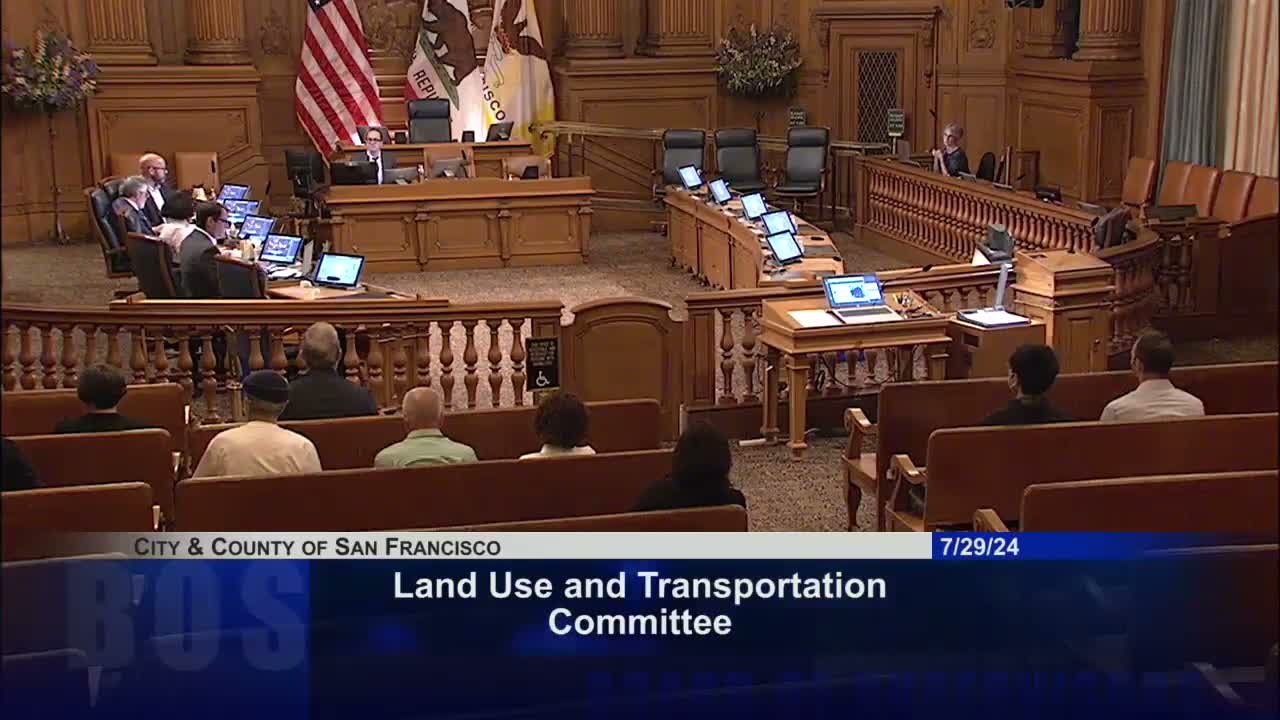
The Land Use and Transportation Committee voted July 29 to send a resolution updating San Francisco's Infill Opportunity Zone (IoZ) to the full Board of Supervisors with a positive recommendation.
Supervisor Rafael Mandelmann, sponsor of the resolution and chair of the Transportation Authority, said the change brings the city into alignment with recent state law and broadens the IoZ to an area that had been expanded by prior state revisions. Chun Ho Chow, a transportation modeler at the Transportation Authority, told the committee the update would exempt roadway segments and intersections inside the revised IoZ from vehicular level of service (LOS) deficiency planning and allow the authority to use alternative performance measures that emphasize movement of people and goods rather than private-vehicle delay.
Chair Mirna Melgar questioned the methodology used to map the zone, calling out exclusions on parts of the West Side (including sections of Brotherhood Way, Monterey Boulevard and Sloat Boulevard) and asking whether transit stops such as Daly City BART or local Muni stations determined inclusion. Chow said the IoZ mapping follows state law and the regional transportation plan: typically locations within roughly a half-mile of a major transit stop or a high-quality transit corridor qualify, and service-frequency thresholds (about 15-minute headways during peak commute hours) determine eligibility. He added that Daly City BART could be used to set the boundary where service meets the criteria, because the definition is not restricted by jurisdictional lines.
There were no public speakers on the item. Chair Melgar moved to recommend the resolution to the full Board; Vice Chair Dean Preston and President Aaron Peskin also voted aye. The clerk recorded three ayes and the motion passed.
The committee's action advances the update to the Board of Supervisors, where the full body will consider the ordinance along with any additional public comment. The change would primarily alter how congestion is measured in parts of the city that state law now designates as infill opportunity areas.