Get Full Government Meeting Transcripts, Videos, & Alerts Forever!
Get email alerts on the Power Outage topic
No spam. Unsubscribe anytime.
PG&E and City Officials Outline Cause and Communication Failures from April 21 Outage
Summary
PG&E attributed an April 21 outage that affected about 88,000 customers to a failed 12 kV breaker at the Larkin substation and pledged a 6–8 week root‑cause analysis; city agencies praised first‑responder work but flagged shortcomings in how information was relayed to supervisors and the public during the outage.
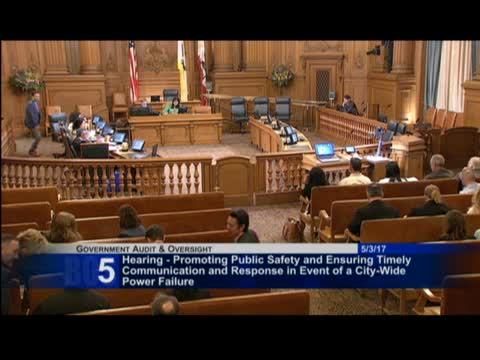
SAN FRANCISCO — City officials and PG&E told the Government Accountability & Oversight Committee on Wednesday that a failed 12 kilovolt circuit breaker and ensuing fire at the Larkin substation caused a widespread power outage on April 21, and they agreed they must improve how incident information is communicated to elected officials and the public.
Papia Gamblin, PG&E director of public affairs, opened the company’s presentation with an apology: “We are deeply sorry…we did not meet our standards that day,” and said PG&E will work with city offices to improve communications and customer claims processes.
Barry Anderson, PG&E vice president of electric distribution, described the technical timeline: at about 9 a.m. a 12 kV circuit breaker failed at Larkin Substation, ignited insulation and produced a fire that ultimately interrupted service to roughly 88,000 customers; crews worked with the San Francisco Fire Department to extinguish the blaze. Anderson said PG&E has hired a third‑party engineering firm for a root‑cause analysis expected in six to eight weeks and is reinspecting local substations.
City Department of Emergency Management director Anne Kronenberg presented an agency timeline and 9‑1‑1 surge statistics. DEM issued an SF Alert at about 9:39 a.m., activated surge staffing for the dispatch center and reported 405 emergency calls between 9 and 10 a.m., of which 226 were abandoned; DEM said all abandoned calls were returned by 10 a.m. Kronenberg said DEM will revise its PG&E notification trigger from 5,000 to 1,000 customers to ensure earlier contact.
First‑responder presentations emphasized field performance but echoed concerns about public and legislative notifications. Deputy Chief Mikael Ali (SFPD) described the near‑term unified command structure and coordination with schools and transit; Chief Joanne Hayes White (SFFD) said the department extinguished the equipment fire using dry chemical and CO2 units and that no evacuation order was necessary. Jeff Flynn (SFMTA) described deployment of nearly 100 parking control officers and motor‑coach substitutions to maintain transit safety while substations were offline.
Public commenters urged utilities and the city to invest in resilience measures (for example, solar backup for elevator operations) and questioned whether procurement or cost‑cutting played any role in equipment failure. Committee members asked for clearer protocols about who notifies the Board of Supervisors during incidents and for improved outreach channels to reach residents who do not use social media.
The committee moved to file the hearing record after departments committed to follow‑ups on notification protocols and after‑action reviews.