Get Full Government Meeting Transcripts, Videos, & Alerts Forever!
Get email alerts on the Proposition A Spending topic
No spam. Unsubscribe anytime.
Supervisors Press MTA Over Slow Use of $500 Million Proposition A Bond
Summary
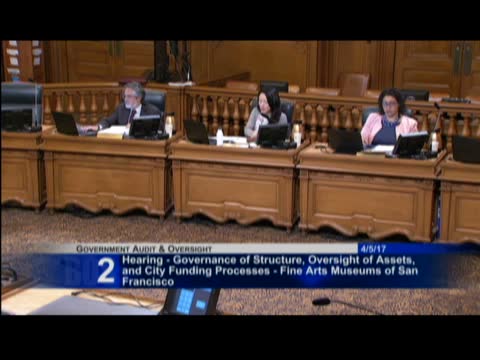
At an April 5 Government Audit & Oversight Committee hearing, President London Breed and supervisors questioned SFMTA officials about slow spending of the 2014 Proposition A $500 million bond; SFMTA said community outreach, contracting challenges and project readiness slowed the first tranche but that spending is set to accelerate.
San Francisco supervisors on April 5 pressed the San Francisco Municipal Transportation Agency (SFMTA) to explain why, nearly three years after voters approved the $500 million Proposition A general obligation bond in November 2014, a relatively small share of the authorized funds had been spent.
President of the Board London Breed opened the Government Audit & Oversight Committee hearing saying the bond was approved by voters with strong majorities and that "I am concerned that the MTA is misusing our trust," pointing to figures that showed only a small portion of the total bond package in the ground. Breed and other supervisors warned that holding large amounts of bond proceeds off the street risks paying interest unnecessarily and eroding the purchasing power of the funds.
The context: Proposition A authorized up to $500 million in general obligation bonds to fund Muni reliability and accessibility improvements, street repairs and safety projects. SFMTA Director Ed Riskin told the committee the agency and partner departments have ramped up capital delivery but acknowledged the pace of spending on the first issuance was slower than elected officials expected. He said the first issuance (authorized by the Board and received in mid-2015) was for roughly $66 million of project funds and that as of February the agency had expended about 22% of that first issuance and encumbered another roughly 18%.
Riskin said a primary cause of delay was his own earlier misestimation of how much community engagement and detailed design would be required after the Transit Effectiveness Project's conceptual approvals. "When it came to the detailed design, it took us much more time in the community process and the public process to get the buy-in and support that we needed in order to move these projects forward," he said, adding that the agency has tightened interagency coordination with Public Works and the San Francisco Public Utilities Commission (PUC), established a project controls unit, increased training for project managers and improved contracting oversight.
Committee members and witnesses raised other causes: contracting market pressures (insufficient bidders leading to rebids), contractor performance issues that required termination and rebidding, and the complexity of coordinating utility and right-of-way work across multiple agencies. Controller Ben Rosenfield told the committee his office had flagged a low early spend rate on the bond in an annual report and said schedule optimism and interagency coordination are recurring causes of delayed delivery across municipal GO bond programs.
PUC staff presented a comparison to the Water System Improvement Program (WESIP), a $4.8 billion program that used short-term commercial paper for early work and later bond issuances to finance construction; that program experienced intense financing and spending activity in 2010–2012 and illustrates how staged financing and planning can accelerate outlays when projects are mature.
Public commenters offered mixed views. Diana Anderson, a neighborhood business owner, urged caution about "rushing to spend the money" and criticized street reconfigurations and concentrated construction in business corridors. Members of the Citizens General Obligation Bond Oversight Committee said they have been meeting regularly with MTA staff and recommended focusing oversight on the current tranche (the first issuance) while monitoring the larger $500 million program.
What happens next: Director Riskin said the agency expects to seek a second issuance later in the year (he cited a planned second issuance of about $118 million) and may request a supplemental appropriation to reallocate funds to projects that are ready to build. The committee voted to continue the matter to the call of the chair and requested a follow-up report from the Controller comparing spend rates across recent bond series and updated expenditure figures.
The hearing did not produce a formal change in policy on the spot, but supervisors said they expect to continue oversight and to explore administrative options (including shifting appropriations to projects that can be advanced sooner) to accelerate delivery of transportation improvements.