Get Full Government Meeting Transcripts, Videos, & Alerts Forever!
Get email alerts on the Eviction Enforcement topic
No spam. Unsubscribe anytime.
San Francisco supervisors hear tenants and agencies on rise in alleged fraudulent owner move‑in evictions
Summary
Supervisors Jane Kim and Aaron Peskin convened a GAO hearing after media reporting and tenant testimony about owner move‑in (OMI) evictions. Rent Board, District Attorney and City Attorney described limited tools; tenants urged stronger enforcement, longer statutes of limitation and private enforcement rights.
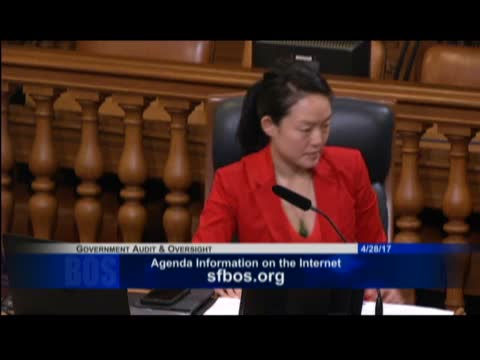
Supervisor Jane Kim opened a special Government Accountability and Oversight Committee hearing on April 28, 2017, saying the city had seen “more than 8,000 people in San Francisco evicted from their homes over the last 4 years” and that investigative reporting suggested as many as one in four owner move‑in (OMI) eviction filings may be fraudulent. The hearing brought together the Rent Board, the District Attorney’s Office, the City Attorney’s Office and more than 40 public speakers, many of them tenants who described buyouts, repeat OMIs and difficulty mounting legal challenges.
The Rent Board’s executive director, Robert Collins, told supervisors the board collects eviction notices and tracks trends for roughly 173,000 regulated units. Collins said the board receives roughly 400–500 reports per year alleging wrongful eviction and can investigate informally and, rarely, hold investigatory hearings; in the last five years the Rent Board scheduled two investigatory hearings and held one. He emphasized the board’s limited tools—no subpoena power—and said it records notices of constraints on title and makes referrals to other city agencies and, when warranted, to the District Attorney.
Evan Acheron, managing attorney in the District Attorney’s Special Prosecutions Unit, described a legal constraint on prosecuting some eviction‑related fraud. He told the committee that California Supreme Court precedent (Action Apartment Association v. City of Santa Monica, 2007) and the litigation privilege have curtailed prosecutions of some claims tied to using the court process. Acheron said proving fraudulent intent at the time an OMI notice is filed is difficult and that, under the current legal framework, the DA’s office largely stopped bringing those prosecutions after the 2007 decision.
Peter Keith, chief attorney for the City Attorney’s Neighborhood and Residential Safety division, described civil options the city can pursue. He said the City Attorney can bring consumer‑protection suits under California Business and Professions Code §17200, tenant harassment cases under the San Francisco Administrative Code, and suits under San Francisco Administrative Code §37.9 for wrongful evictions. Because the city’s remedies are civil (preponderance of evidence standard), he said the office can obtain injunctions, penalties and court supervision in large, pattern‑based cases—but those suits require significant investigative resources and typically are reserved for large or repeated wrongdoing.
Public comment filled much of the hearing. Tenants and tenant advocates recounted OMI cases in which buyouts followed notice, units remained vacant or were re‑rented at higher market rates, and alleged owner or relative move‑in claims never materialized. Several tenant attorneys and advocates urged concrete statutory changes: require objective proof the owner or qualifying relative actually moves in within a defined period, extend the statute of limitations for wrongful eviction claims (several speakers proposed three years), make filing notices with the Rent Board an affirmative defense to unlawful‑detainer actions when landlords fail to file, and authorize third‑party nonprofit private rights of action so community organizations can litigate systemic abuses.
Supervisors acknowledged the tension between available criminal remedies and civil enforcement, and said they would work with the Rent Board, the City Attorney and the DA to craft enforceable ordinance amendments. Supervisor Peskin said the goal is to craft a package that is both enforceable and effective at deterring fraud. The committee voted to file the hearing record for Item 1; supervisors indicated two legislative proposals were already pending for further development.
The committee did not adopt immediate regulatory changes at the hearing; next steps were described as drafting and vetting legislation with city agencies and community stakeholders.