Get Full Government Meeting Transcripts, Videos, & Alerts Forever!
Get email alerts on the Ems Response Times topic
No spam. Unsubscribe anytime.
Committee hears updates on ambulance response, dashboards and surge planning; continues item for follow-up
Summary
The Government Audit & Oversight Committee convened a wide-ranging hearing on ambulance and 911 response performance. Fire, DEM, DPH, the controller's office and private providers described investments, dashboards and next steps; the committee continued the item to the call of the chair for additional follow-up.
The Government Audit & Oversight Committee held an extended hearing on March 1 examining ambulance response times, 9-1-1 call-center performance, hospital diversion and operational fixes to reduce ambulance unavailability.
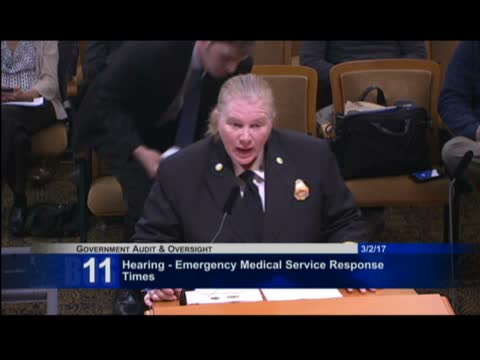
Fire Chief Joanne Hayes White said the city has improved its ambulance fleet and staffing since 2014, expanding the fleet, taking delivery of 33 new ambulances over five years and investing about $5 million in equipment (including approximately $800,000 in FEMA grant funds). Chief Hayes White described recent program changes — per-diem H8 paramedics, expanded supervisory staffing at Station 49 and reconvening the ambulance working group — and said the city met February response-time goals, noting that "in the most recent month, last month, February, the city met its paramedic and ambulance time response goals." She clarified that a January 13 call that took 21 minutes to resolve had initially been classified as code 2 and later upgraded.
Heather Littleton of the controller's city performance unit outlined a system-wide effort to create public EMS performance dashboards and a two-year data working group that produced publicly accessible metrics for dispatch intervals, response intervals (including code 3 ambulance-on-scene within 10 minutes targets), ambulance destinations and hospital diversion. The controller's team said the dashboards implement a shared data-cleaning methodology (for example, handling calls upgraded from code 2 to code 3) and are live and updated monthly.
DEM Deputy Director Mike Dayton and 911 leadership described operational coordination steps: a daily 7 a.m. call to review schedules, CAD upgrades (including GPS tracking of units), strengthening interoperability with private providers AMR and King and discussions about revising the city's low-level ambulance policy to free surge units more quickly. Dr. John Brown, medical director of the EMS Agency, discussed hospital "standby" emergency department designations, causes of diversion and the importance of reducing ambulance wall time at hospitals toward a 30-minute target to improve availability.
Labor and the firefighter union urged further expansion of personnel. Tom O'Connor, president of Local 798, said call volume has continued to grow without matching personnel increases and warned of staff burnout.
After presentations and public testimony, the committee continued item 11 to the call of the chair for follow-up by the ambulance working group and additional reporting.