Get Full Government Meeting Transcripts, Videos, & Alerts Forever!
Get email alerts on the Retail Hours Restriction topic
No spam. Unsubscribe anytime.
Committee adopts amendments and forwards two‑year Tenderloin retail‑hours pilot to the Board
Summary
After an SFPD presentation and extensive public comment, the committee adopted amendments narrowing the midnight–5 a.m. retail-hours restriction in the Tenderloin, required a six-month impact report, and forwarded the amended ordinance to the Board while duplicating the file for further work on the private right of action.
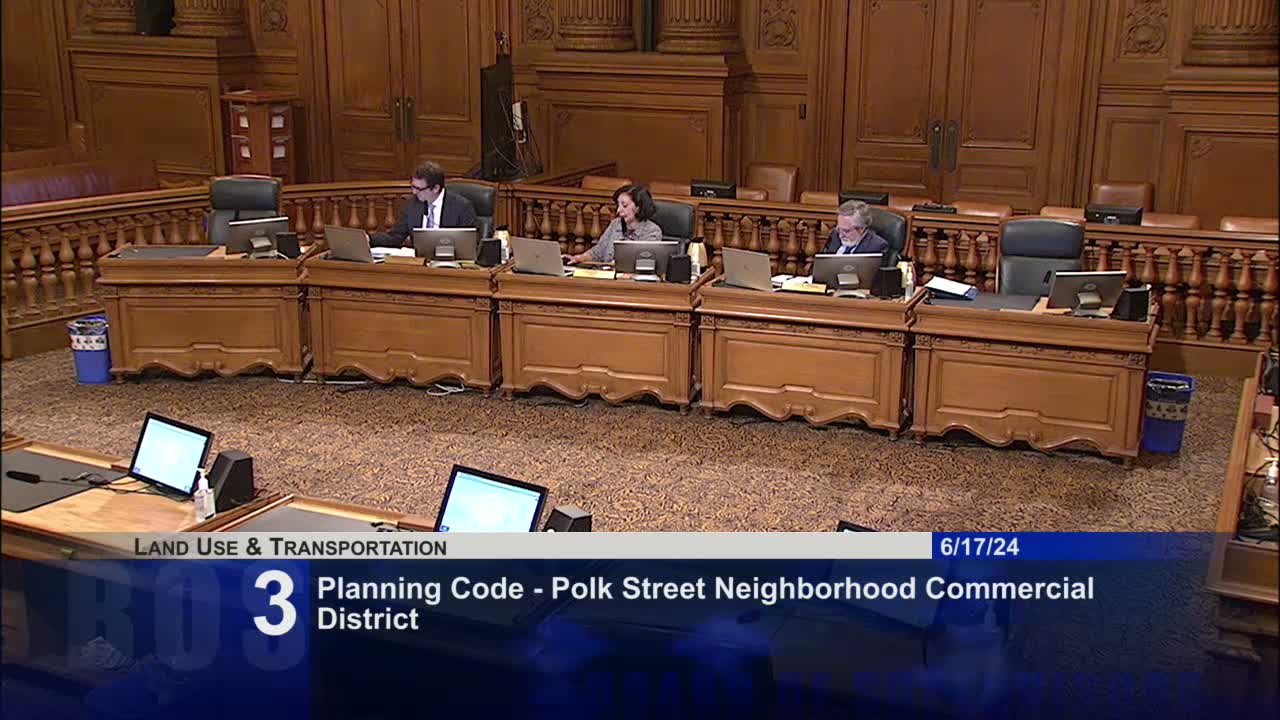
The Land Use and Transportation Committee on June 17 advanced an amended ordinance authorizing a two‑year pilot program that would prohibit certain retail food and tobacco establishments from operating between midnight and 5 a.m. in a defined high-crime area of the Tenderloin, and would authorize the San Francisco Department of Public Health to impose administrative fines for violations.
Commander Derek Lou of the San Francisco Police Department presented photos and a heat map of Part 1 crimes and narcotics incidents that SFPD says concentrate near late‑night retail outlets. "What we're asking for is a restriction for operating hours for nighttime retail food and tobacco establishments from midnight till 5AM for a period of 2 years," Commander Lou said, noting community meetings and recent incidents, including a shooting near 77 McAllister.
Vice Chair Dean Preston moved a package of negotiated amendments aimed at protecting long‑standing small businesses and improving implementation. Key amendments adopted by the committee include:
- Exempting ABC‑licensed corner stores from the midnight closure and allowing them to operate until 2 a.m. consistent with their ABC license; - Requiring multilingual outreach and education to impacted businesses led by the Office of Small Business and DPH; - Requiring a detailed six‑month report on impacts to safety and to affected businesses, with a process for OEWD to collect merchant input; - Narrowing enforcement to administrative fines (DPH authority) and clarifying this is not a criminal penalty; and - Modifying the private right of action so a complainant must notify the city and allow it an opportunity to act before filing suit (that change requires additional city‑attorney review and the committee duplicated and continued the file to the July 1 meeting to finalize that language).
Public comment was extensive and divided: many residents, tenant‑advocacy groups, neighborhood business improvement districts, UC San Francisco housing officials, and service providers urged the committee to adopt the pilot to reduce crowding, open‑air drug markets, violence and unsanitary conditions. Several merchant representatives supported the concept but requested a shorter pilot (one year with a six‑month review), narrower geographic coverage, or carve‑outs for stores that do not sell tobacco or alcohol.
Dean Preston emphasized the need to balance safety and small‑business impacts and described the amendments as the product of negotiations with merchants, residents, the mayor’s office, DPH and SFPD. "We believe these changes will allow the city to pilot the approach and work to address street conditions in the Tenderloin, especially during nighttime hours, while also protecting small businesses that are not doing anything wrong from being unfairly punished," Preston said.
The committee adopted the amendments and voted 3–0 to recommend the amended ordinance as a committee report to the Board of Supervisors (it will appear on the Board agenda June 18, 2024). The committee also voted to duplicate the file and continue the duplicated version to the July 1 committee meeting to finalize the private‑right‑of‑action language.
Implementation notes: DPH will be the lead enforcement department, issuing notices of violation and conducting director hearings; the amendments require coordinated outreach and a six‑month evaluation that must include reporting from SFPD, OEWD and DPH on crime, street conditions and business impacts.
Next steps: The amended ordinance is scheduled for Board consideration; a continued file will return to the Land Use and Transportation Committee on July 1 to finalize private‑law procedural language.