Get Full Government Meeting Transcripts, Videos, & Alerts Forever!
Get email alerts on the Awss topic
No spam. Unsubscribe anytime.
SFPUC and Fire Department outline AWSS upgrades, supervisors press for clarity on West-Side coverage
Summary
PUC and Fire Department officials told the committee that the Auxiliary Water Supply System is being strengthened with bond-funded pipeline and pump work, but supervisors and public safety witnesses pressed for independent cost comparisons, district-level reliability details and raised concerns about a shift from a proposed flexible hose system to potable 'co-benefit' pipelines for West-Side coverage.
San Francisco's Public Utilities Commission (SFPUC) and Fire Department gave the Government Audit and Oversight Committee an update March 15 on the city's Auxiliary Water Supply System (AWSS), detailing recent maintenance, capital upgrades and a shift away from a flexible water supply system toward a mix of pipeline extensions and potable "co-benefit" mains.
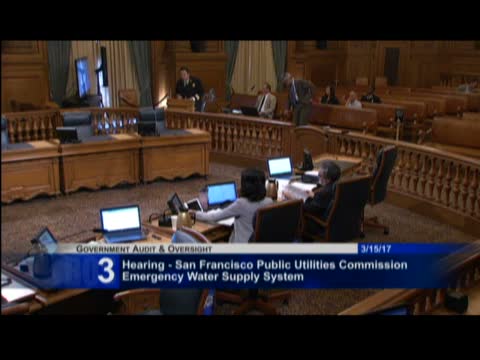
The hearing, led by Chair Jane Kim and sponsored by Supervisor Peskin, brought SFPUC project manager David Myerson and David Briggs alongside Assistant Deputy Chief Anthony Rivera of the San Francisco Fire Department (SFFD). Briggs said the PUC cleared sediment from seawater channels that feed AWSS pump stations and repaired leaks that now retain roughly 500,000 gallons in the system; Twin Peaks Reservoir now holds 10 million gallons and supports gravity-fed, high-pressure delivery crucial after major seismic events. "We're taking it on, finding the resources and scheduling difficult work," Briggs said of maintenance and upgrades.
Why it matters: AWSS supplies high-pressure water for firefighting when normal systems fail after earthquakes. Supervisors repeatedly pressed staff to explain how planned projects would raise reliability for neighborhoods on the West Side, where current coverage lags downtown.
What officials proposed: Myerson described two near-term projects funded in part by reassigned money from a flexible water supply concept (FWSS) and 2014 bond funds: an AWSS pipeline extension along Victoria and Holloway and a Sunset/Richmond potable "co-benefit" pipeline. Myerson said the Sunset/Richmond full project is approximately $52 million and that the PUC expects to use about $7.85 million of 2014 bond funds for phase 1 work, with the remainder funded by water rates and potentially future bonds.
On FWSS: Assistant Deputy Chief Rivera said SFFD personnel tested the 12-inch hose concept in Berkeley and found "logistical issues that were prohibitive," citing deployment, maintenance and proprietary fittings; he said neither department purchased the specialized hose and that FWSS would not be practical for San Francisco.
Supervisors' concerns: Several supervisors, including Supervisor Feuer and Supervisor Peskin, asked for district-level briefings and independent analysis comparing the PUC's co-benefit approach to a full AWSS expansion. Feuer noted that parts of the Richmond district still show relatively low modeled reliability and asked how a partial pipeline phase materially increases protection. Myerson said reliability modeling uses demand values developed with third-party reviewers and that completing planned projects could raise citywide modeled reliability from about 67% (post-2010 work) to about 87% after current projects; he and staff acknowledged some figures and slides would be clarified and offered follow-up briefings.
Public safety warning: Thomas Duthier, a Richmond resident and retired SFFD captain, warned the committee that relying on cisterns and limited potable mains rather than high-pressure AWSS mains could leave tens of thousands of structures vulnerable after a major earthquake, saying cisterns require engine companies both to extract and to pressurize water and that the West Side could face dozens of simultaneous fires.
Peer review and design changes: PUC staff said they are engaging third-party reviewers (AECOM and academic experts) and moving design criteria away from legacy materials (e.g., leaded fittings). Katie Miller of the PUC confirmed AECOM is conducting a peer review of design approaches, including joint restraints (tie rods) and other seismic performance elements.
Next steps: The committee voted to continue the AWSS item to the call of the chair for additional hearings and district briefings. The committee asked the PUC for district-specific project lists, the methodology and assumptions behind reliability maps, independent cost comparisons between co-benefit and full AWSS expansions, and clarification of bond vs. rate funding on specific phases.
Ending: The PUC and the fire department left the committee with follow-up commitments; supervisors emphasized that the conversation must balance cost against the urgent public-safety need to provide reliable, deployable high-pressure water in the city's most vulnerable neighborhoods.