Get Full Government Meeting Transcripts, Videos, & Alerts Forever!
Get email alerts on the Building Safety 301 Mission topic
No spam. Unsubscribe anytime.
Supervisors and expert probe peer-review gaps after Millennium Tower settlement concerns
Summary
A February 2, 2017 Government Audit & Oversight Committee hearing examined peer-review practices around 301 Mission Street (Millennium Tower). Professor Jack Maley testified he was retained by the developer to review seismic design and that his scope did not include geotechnical verification; supervisors and residents urged independent geotechnical review and accountability.
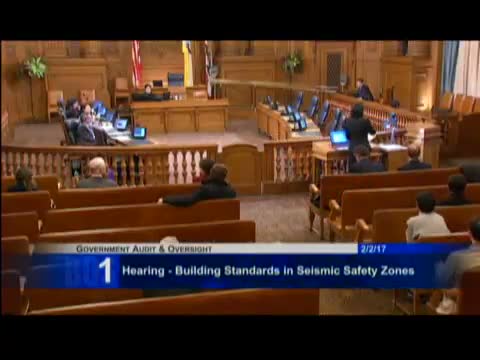
Chair Jane Kim and Vice Chair Supervisor Aaron Peskin convened a Feb. 2, 2017 hearing of the San Francisco Board of Supervisors’ Government Audit and Oversight Committee to review building standards and seismic safety for tall buildings, focusing on 301 Mission Street, commonly known as the Millennium Tower.
Professor Jack Maley, a UC Berkeley structural engineering professor who served as a peer reviewer on multiple high-rise projects, testified that Millennium Partners retained him to conduct an "internal peer review" focused on the concrete tower's seismic design. Maley said his contract (marked in materials as JPM 1) limited his scope to structural-seismic matters and did not include a geotechnical peer review. He told the committee that foundation-only permit letters are often requested late in the process and that his letter expressed that the foundation design "is compliant with the principles and requirements of the building code," while noting he had not performed geotechnical verification.
Maley described technical choices he recommended, including adding shear reinforcement to a roughly 10-foot-thick concrete mat and designing outriggers to ensure adequate stiffness and strength. He also recounted an earlier nearby AD Natoma peer review where differing geotechnical reports produced settlement estimates of about 5 inches versus about 11 inches; Maley said the discrepancy largely resulted from one report using a building weight about 25 percent higher than the correct value, and that correcting that input brought the estimates into closer agreement.
Supervisors pressed Maley and Department of Building Inspection (DBI) staff on why a geotechnical peer reviewer had not been engaged for 301 Mission and why his letters to DBI did not include stronger caveats about dewatering or Transbay-related tunneling risks. Maley said the project was treated as code-prescriptive when he was retained and that his scope did not include geotechnical analysis; he added he had not seen some late-2005 in-situ indicator pile testing documents and therefore could not rely on them.
DBI Assistant Director Ron Tom explained the "cloud" (delta) markings on structural drawings represent iterative changes and noted that older drawing records are managed under DBI records procedures and may require formal requests for full access.
Residents and owners testified during public comment. Pat Dodson, a resident at 301 Mission, alleged the developer and the city knew the foundation was inadequate and cited a 2009 report of 8.3 inches of settlement; Nina Agabian, an owner at 301 Mission, urged an independent life-safety assessment and criticized reliance on developer-produced reports. Supervisor Peskin said the city has been "outgunned" by the technical complexity and asked the city to move toward direct contracts with independent peer reviewers and greater transparency.
The committee did not adopt an immediate technical remedy during the hearing; members emphasized continuing oversight, more robust geotechnical involvement in future reviews, and follow-up with DBI to obtain the underlying drawings and geotechnical documents.
The committee continued its inquiry; Professor Maley and DBI staff provided documents to the panel and the item was continued for further review.
The committee is expected to pursue additional records and to consider reforms to peer-review contracting and scope going forward.